How Much Gold and Silver Can You Carry to India in 2026? Latest Customs Rules

How Much Gold and Silver Can You Carry to India? Rules Explained

As of February 2026, Indian residents and travelers of Indian origin returning after more than one year abroad can bring **gold jewelry** duty-free up to 40 grams for women and 20 grams for men/others. The limit is now based purely on weight, with no value cap. For stays abroad over six months, eligible passengers can import up to 1 kg of gold and 10 kg of silver (subject to customs duty). All excess items must be declared at customs.

India has strong cultural and economic connections with gold and silver. Strict customs regulations by the Central Board of Indirect Taxes and Customs (CBIC) control their import to prevent smuggling and manage the economy. This guide explains the latest Baggage Rules 2026, duty-free allowances, applicable duties, declaration requirements, and practical tips for travelers.

Gold Import Regulations 2026

Under the new Baggage Rules 2026 (effective February 2, 2026), eligible returning Indian residents, NRIs, and persons of Indian origin who have stayed abroad for more than one year enjoy a simplified duty-free allowance for gold jewelry based only on weight:

  • Female passengers: Up to 40 grams of gold jewelry
  • Male passengers / others: Up to 20 grams of gold jewelry

These limits apply to jewelry for personal use only. Gold in any other form (bars, coins, bullion) does **not** qualify for duty-free allowance and must be declared with payment of customs duty. The maximum gold that can generally be imported as baggage is up to 1 kg, subject to duty.

Important Note: Jewelry studded with precious stones or pearls may face additional scrutiny. Always carry proof of purchase (invoices, certificates) to establish personal use and origin.

Eligibility for Higher Allowances

Passengers must have resided abroad for over six months (or one year for the special jewelry concession). Short visits to India during the qualifying period are generally disregarded for eligibility calculations.

Silver Import Regulations

Silver has no dedicated duty-free weight-based allowance like gold jewelry. Eligible passengers (Indian nationals or passport holders residing abroad for over six months) can import up to 10 kg of silver in forms such as jewelry, bars, or utensils, but it is subject to applicable customs duties and must be declared.

Customs Duties on Gold and Silver

As of 2026, the basic customs duty on gold remains at approximately 6% (including Basic Customs Duty and AIDC). An additional 3% GST typically applies on the assessed value, bringing the effective total closer to 9%. Silver follows a similar structure, with specific rates per kilogram for bars.

Duty is calculated on the current market value at the time of arrival (not your purchase price). Gold bars/coins and silver in non-jewelry form are fully dutiable. Payment is preferably made in convertible foreign currency.

Pro Tip: If you plan to take the gold or silver jewelry out of India later, request an export certificate from customs upon arrival to avoid paying duty again on re-export.

Declaration Process and Tips for Travelers

Always use the Red Channel if you have items to declare (gold/silver exceeding duty-free limits). You can also use the ATITHI mobile app for advance declaration where available.

  1. Carry original purchase invoices and certificates of authenticity.
  2. Declare all gold and silver exceeding free allowances honestly.
  3. Pay any applicable duty in foreign currency at the customs counter.
  4. Avoid commercial quantities — import only for personal use or gifting.
  5. Check the latest rules on the official CBIC website before travel, as regulations can change.

Warning: Failure to declare dutiable items can result in confiscation, heavy penalties, or legal action under the Customs Act, 1962. Never attempt to conceal gold or silver.

Frequently Asked Questions

How much gold and silver can I carry to India in 2026?

Eligible returning passengers (after 1+ year abroad) can bring 40g gold jewelry (women) or 20g (men) duty-free. Up to 1 kg gold and 10 kg silver can be imported subject to customs duty and declaration.

What is the customs duty on gold and silver in India in 2026?

Gold attracts approximately 6% customs duty plus 3% GST. Silver has similar base rates, with specific per-kg charges for bars. Duty is assessed on current market value.

How many grams of gold can I bring from the USA to India in flight?

Duty-free: 40 grams for women and 20 grams for men (jewelry only). Additional gold up to 1 kg total is allowed but dutiable and must be declared.

Can we carry silver from the USA to India?

Yes, up to 10 kg of silver (jewelry, bars, or utensils) is permitted for eligible passengers, subject to declaration and payment of applicable customs duty.

Is there an 80/50 rule for silver in India?

No specific 80/50 rule applies in the 2026 baggage regulations. Silver import follows general quantity limits (up to 10 kg) with full declaration and duty requirements.

Is silver cheaper in India or the USA today?

Prices fluctuate daily based on international markets, exchange rates, and local taxes. Compare current spot prices plus import duties and making charges before deciding where to buy.

Do I need to declare gold jewelry within the duty-free limit?

It is advisable to declare even duty-free jewelry to avoid any confusion at customs, especially if the items have high value or stones.

What happens if I exceed the gold limit without declaring?

Excess undeclared gold or silver can be confiscated. You may face penalties, fines, or legal proceedings. Always use the Red Channel for dutiable items.

Official CBIC Customs Website
Reserve Bank of India How much gold can you bring to India ? Can I Take Gold Biscuit to India? Customs Rules Explained

Bumped from a Flight in India? Overbooking Rules, Compensation & Passenger Rights Explained

Denied boarding in India? Learn compensation rules, passenger rights

Getting bumped from a flight in India can feel frustrating—but here’s the surprising part: you may be entitled to compensation up to ₹20,000, along with meals, hotel stays, and alternate flights.

Airlines often overbook flights to manage no-shows, but strict rules ensure passengers are protected. This guide walks you through compensation, rights, and how to handle the situation like a pro.

Table of Contents

  • Can Airlines Bump You?
  • Overbooking in India Explained
  • Compensation Rules
  • Who Gets Bumped?
  • Passenger Rights & Care
  • Step-by-Step What To Do
  • Pros & Cons
  • FAQs

Rules You Must Know

Never Do Always Do Instead
Arrive Late at Airport Check-in Early (up to 48 hrs)
Accept Verbal Promises Get Written Denied Boarding Proof
Ignore Receipts Keep All Documents & Bills
Volunteer Without Negotiation Negotiate Compensation First

Can Airlines Bump You from a Flight?

Yes, airlines in India can legally deny boarding due to overbooking. However, they must first ask for volunteers before forcing anyone off a confirmed seat.

If you checked in on time and still got bumped, you are legally entitled to compensation and assistance.

Does Overbooking Happen in India?

Yes—overbooking is common among airlines to offset no-shows. It’s a global practice, but India ensures passengers are denied boarding at the gate, not removed from the plane.

Airlines typically overbook by 5–15% to maximize seat occupancy.

Compensation Rules (2025–2026)

You can receive up to ₹20,000 compensation depending on your delay and choice.

Situation Your Compensation
Alternate flight within 24 hours 200% of fare (Max ₹10,000)
Alternate flight after 24 hours 400% of fare (Max ₹20,000)
No alternate flight accepted Full refund + 400% (Max ₹20,000)

Mandatory Passenger Care

  • Free meals & refreshments
  • Hotel stay (if next-day flight)
  • Alternative travel arrangements

Who Gets Picked for Bumping?

  • Late check-in passengers
  • Low fare ticket holders
  • No seat assignment travelers

Frequent flyers and premium passengers are least likely to be bumped.

What To Do If You Get Bumped

  1. Ask for written denied boarding proof
  2. Confirm compensation eligibility
  3. Request meals or hotel if delayed
  4. Keep all receipts
  5. File complaint if unpaid

Pros & Cons of Airline Overbooking

Pros

  • Higher flight availability
  • Lower ticket prices overall
  • Chance to earn compensation

Cons

  • Risk of denied boarding
  • Travel delays
  • Stress & inconvenience

Pro Tips to Avoid Getting Bumped

  • Check-in as early as possible
  • Select your seat in advance
  • Join airline loyalty programs
  • Avoid last-minute boarding

FAQs

What happens if a flight is overbooked in India?

You may be denied boarding but are entitled to compensation, alternate flights, and care services.

What are my rights if I get bumped?

You have the right to compensation, refund or alternate flight, and free meals or hotel if required.

How much compensation can I get?

Up to ₹20,000 depending on delay and whether you accept an alternate flight.

What if no one volunteers?

The airline will deny boarding involuntarily and must compensate affected passengers.

Which passengers are least likely to be bumped?

Frequent flyers, business class travelers, and early check-in passengers.

Can I file a complaint if airline refuses to pay?

Yes, you can file a complaint with DGCA or approach consumer court.

Are Insulin Syringes Allowed on Airplanes? Travel Tips for Diabetics

Travelling with Diabetes: Can You Carry Insulin Syringes?

Are Insulin Syringes Allowed on Airplanes?

Yes—insulin syringes are allowed on airplanes when accompanied by insulin or prescribed injectable medication. With the right preparation, flying with diabetes can be smooth, stress-free, and fully manageable.

This guide walks you through everything you need to know—from TSA rules to smart packing strategies—so you can travel confidently and focus on enjoying your trip.

Can I Carry Insulin Syringes on a Plane?

Yes, insulin syringes are permitted in carry-on luggage. Security agencies allow diabetic supplies such as insulin pens, syringes, and glucose meters after proper screening. Always declare these items at the checkpoint to avoid delays. The American Diabetes Association

Key Rule: Insulin syringes must be accompanied by insulin or prescribed medication to be allowed through security.

How to Carry Insulin Injections in Flight

  1. Keep Original Packaging: Helps security quickly identify medication.
  2. Use a Separate Bag: Makes inspection easier and faster.
  3. Carry Documentation: A prescription or doctor’s note adds clarity.
  4. Use Carry-On Only: Prevents loss and protects insulin from extreme temperatures.

Pack at least twice the supplies you think you’ll need in case of delays or emergencies.

What to Do with Insulin Needles When Traveling

Used needles should always be stored safely in a sharps container. Carry a travel-size container and follow disposal rules at your destination.

Never dispose of loose needles in airplane trash or public bins—always use proper containers.

Can We Carry Injections in Flight?

Yes, injectable medications are allowed in cabin baggage. Declare them during screening and keep them clearly labeled to avoid confusion.

How to Fly with Injectable Medication

  • Inform security officers before screening
  • Keep medications easily accessible
  • Use insulated bags for temperature control
  • Avoid placing medication in checked luggage

Is Needle Allowed in Cabin Baggage?

Yes, needles including insulin syringes and lancets are allowed when paired with prescribed medication. There is no strict limit as long as they are medically necessary.

Do You Need a Letter from Your Doctor?

While not always required, carrying a doctor’s letter is strongly recommended. It can speed up security checks and help explain your medical needs.

Without Doctor’s Letter With Doctor’s Letter
Possible delays Faster screening
More questions Clear verification
Uncertainty Peace of mind

How to Store Insulin While Traveling

Best Practices

  • Use insulated travel cases
  • Keep insulin at stable temperatures
  • Monitor temperature when traveling long distances

Avoid

  • Freezing insulin
  • Leaving insulin in checked baggage
  • Exposure to extreme heat

FAQ Section

Can you bring diabetic syringes on a plane?

Yes, diabetic syringes are allowed when accompanied by insulin or prescribed medication and declared at security.

Do type 2 diabetics get priority boarding?

Priority boarding is not automatic, but airlines may accommodate medical needs if requested in advance.

How do I pack my insulin needles for flying?

Keep them in original packaging, place them in a separate bag, and carry a sharps container for used needles.

How do diabetics take insulin on a plane?

Insulin can be administered as usual during the flight. Carry supplies in your hand luggage for easy access.

Do I need a doctor's letter to take insulin on a plane?

It’s not always required, but highly recommended to avoid delays and simplify the screening process.

Can insulin go through airport scanners?

Yes, but if you prefer, you can request a manual inspection instead of X-ray screening.

How much insulin can I bring on a plane?

You can bring a reasonable quantity for personal use, including extra supplies for your trip.

By following these guidelines, travelers with diabetes can navigate airport security with confidence. For more information, check the TSA guidelines on unused syringes, Air India’s restricted baggage rules, or the Fact Sheet on Air Travel and Diabetes. Travelling with Medicines to India Safe travels!

Indian Customs Forms 2026: Declaration, Duty-Free Allowance & Compliance Guide

Indian Customs Declaration Form / Customs compliance for International Travellers

Planning your arrival in India? Understanding Indian customs forms and compliance rules can save you time, money, and unnecessary stress at the airport. This guide walks you through everything—from declaration forms and duty-free limits to key compliance rules—so you can travel confidently and stay fully compliant.

The Atithi app is an official mobile tool created by India’s Central Board of Indirect Taxes and Customs (CBIC) for international travelers. It enables passengers to submit digital declarations for baggage, valuables, and currency before arrival, helping reduce airport wait times and making customs clearance faster and more efficient.

Rules Overview

Never Do Use Instead
Carry undeclared currency above limits Declare amounts exceeding USD 5,000 or USD 10,000 total
Use Green Channel with dutiable goods Always choose Red Channel for declarations
Ignore restricted/prohibited items Check regulations before travel

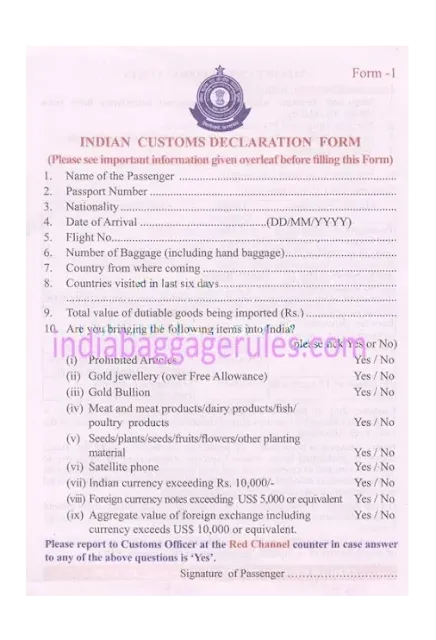
Indian Customs Declaration Form

The Indian Customs Declaration Form is required for travelers carrying dutiable, restricted, or prohibited goods.

How to Fill the Form

  1. Enter personal and passport details
  2. Declare goods like electronics, gold, or high-value gifts
  3. Declare currency exceeding USD 5,000 or total USD 10,000
  4. Submit at customs upon arrival
Indian Customs Declaration Form

Tip: Use the Atithi App to submit your declaration digitally before arrival for faster clearance.

Duty-Free Allowances (2026)

Check full details here: India Duty-Free Allowance 2026

Category Allowance
Indian Residents ₹50,000
Foreign Tourists ₹25,000
Alcohol 2 Liters
Tobacco 100 Cigarettes or 25 Cigars

Used personal items such as clothing and toiletries are fully exempt from customs duty.

Essential Indian Customs Forms

1. Customs Declaration Form

Mandatory for declaring goods and currency.

2. Red vs Green Channel

Green Channel: No dutiable goods

Red Channel: Required if carrying taxable or restricted items

3. Atithi App

Digital platform for submitting declarations in advance.

4. KYC Form

Required for cargo clearance and identity verification.

Key Compliance Rules for Travelers

Failure to declare dutiable goods can result in penalties, confiscation, or legal action.

  • Declare currency above USD 5,000 (cash) or USD 10,000 total
  • Avoid prohibited items like narcotics and wildlife products
  • Pets require NOC, microchip, and vaccination records
  • Report mishandled baggage immediately

Commercial Import Compliance

Required Documentation

  • Manufacturer Invoice
  • Letter of Credit
  • Insurance Documents
  • Import License

Classification System

Goods must be classified under ITC (HS) using 8-digit codes.

Customs clearance is processed through the Electronic Data Interchange (EDI) system for efficiency.

Additional Resources

Customs Guide for Travellers
CBIC Official Website
Bureau of Immigration India

Frequently Asked Questions

Do I need a customs declaration form in India?

Yes, if you are carrying dutiable, restricted, or prohibited goods.

Can I fill out the customs form online?

Yes, you can use the Atithi App to submit declarations before arrival.

What happens if I don't declare goods?

You may face penalties, confiscation, or legal consequences.

Do I need CN22 or CN23 forms?

No, these are for postal shipments, not passenger baggage.

What documents are needed for customs clearance?

Passport, declaration form, invoices (if applicable), and supporting documents.

What are common mistakes on customs forms?

Incorrect values, missing items, and failure to declare currency.

What is the duty-free allowance in India?

₹50,000 for residents and ₹25,000 for foreign tourists.

Is Air Suvidha required?

No, the Air Suvidha form is no longer required for international arrivals to India. Air Suvidha.

Returning NRI Checklist 2026: What to Bring, Declare & Avoid at Indian Customs

Updated for 2026 - Covers new gold rules, duty-free limits, banned items & airport tips

Last Diwali, my cousin flew back to Mumbai after six years in Canada. She had packed carefully -- gifts for everyone, a brand-new laptop, two iPhones (one for her mother), and a beautiful gold necklace she had bought abroad. At the customs hall, she confidently walked through the Green Channel. She was stopped, her bags were checked, and she spent the next two hours at the Red Channel desk paying duty on the second phone and explaining the necklace. It cost her over ₹ 18,000 in unexpected charges and a very stressful homecoming. This guide exists so that doesn't happen to you.

1. Who Counts as an NRI for Customs Purposes?

For Indian customs, you qualify as an NRI if you have lived outside India for more than one year continuously. This status matters because NRIs receive significantly higher duty-free allowances than regular tourists or short-term travelers returning home.

If you have been abroad for less than six months, you are treated as a resident returning from a short trip and receive a much lower duty-free limit. The duration of your stay abroad determines which allowance applies to you.

2. Documents to Carry

Customs officers at Indian airports can ask for any of the following. Keep physical and digital copies of everything before you travel:

  • Valid Indian passport (or OCI / PIO card if applicable)
  • Visa (if you hold a foreign passport)
  • Flight itinerary showing your travel dates and history
  • Purchase receipts for expensive items such as electronics and jewellery
  • Prescription letters from a licensed doctor for medicines
  • Pet health certificates and vaccination records if traveling with animals
  • Currency Declaration Form (CDF) if carrying large foreign currency amounts

Tip: Store scanned copies of all documents in Google Drive or your phone gallery so you can access them even if physical copies are misplaced.

3. What You Can Bring Duty-Free

As of 2026, the general duty-free allowance for NRIs returning after more than one year abroad is ₹ 75,000 per passenger. This covers personal items, gifts, and general goods combined.

Traveler TypeDuration AbroadDuty-Free Limit
NRI / OCI / PIOMore than 1 year₹75,000
Resident returning3 to 6 months₹25,000
Resident returningLess than 3 days₹6,000

Used personal items such as your own worn clothing and a personal laptop are generally not counted toward this limit as long as they are clearly for personal use and not for resale.

4. Gold and Jewellery Rules for NRIs 2026

This is the most frequently asked topic — and the rules changed significantly in early 2026. The old monetary value caps on duty-free gold jewellery have been completely replaced by weight-based limits.

PassengerDuty-Free Gold Jewellery Limit
Female NRI passengersUp to 40 grams
Male and other NRI passengersUp to 20 grams

These limits apply regardless of the current market value of the jewellery. Key points to remember:

  • Applies only to wearable jewellery necklaces, bangles, rings, earrings, and similar items
  • Gold coins, bars, and biscuits are not covered by this allowance
  • Jewellery above these weight limits must be declared at the Red Channel
  • Customs duty applies on excess amounts

Important: Carry purchase receipts or jeweller certificates where possible, especially for high-value pieces. This helps establish value if an assessment is needed.

5. Electronics: Phones, Laptops and Cameras

Electronics are the most common source of customs trouble for returning NRIs. Here is a clear breakdown:

Generally allowed duty-free for personal use:

  • One laptop or tablet
  • One mobile phone
  • A personal camera and accessories
  • One smartwatch or fitness band
  • Personal headphones or earbuds

What raises suspicion:

  • Multiple identical sealed phones or laptops
  • Unopened retail boxes in large quantities
  • Items that appear to be for resale rather than personal use

Tip: If you are gifting a phone to a family member, carry it in your own baggage and have it ready to explain. One extra phone is usually accepted — two or more sealed identical phones is a red flag.

6. Gifts: What You Can Bring for Family

Bringing gifts is one of the great joys of returning home. The rules are straightforward but easy to miscalculate:

  • Gifts are included within your overall ₹ 75,000 duty-free allowance
  • They must be in quantities reasonable for personal gifting — commercial quantities attract duty
  • Expensive branded gifts such as watches, designer bags, or premium perfumes count toward your limit
  • Keep items accessible in your luggage - you may be asked to show them

Tip: Keep a rough running total of your gift values before you pack. It is easy to underestimate when buying across multiple shopping trips abroad.

7. Cash and Foreign Currency Rules

Currency rules are strict and non-negotiable at Indian airports:

  • Indian rupees: You may bring up to ₹ 25,000 into India per passenger
  • Foreign currency cash: No upper limit, but amounts above USD $5,000 in cash (or USD $10,000 total including traveler's cheques) must be declared using a Currency Declaration Form
  • Undeclared large cash amounts can be confiscated on the spot

Warning: Carrying undeclared large sums is treated as a serious offence. If you are bringing funds for property purchase, medical expenses, or family support, carry supporting documentation explaining the purpose.

8. What You Must Declare

Always go to the Red Channel and declare the following:

  • Gold or jewellery exceeding the duty-free weight limits
  • All goods exceeding ₹ 75,000 in total value
  • Foreign currency above USD $5,000 in cash
  • Satellite phones
  • Restricted items for which you hold a license
  • Commercial quantities of any goods
  • Medicines beyond a reasonable personal supply (typically 6 months)
  • Any firearms or weapons (require prior import permission)

Voluntary declaration is always treated far more favorably than goods discovered during baggage inspection.

9. Banned and Restricted Items

Completely banned from import:

  • Narcotics and psychotropic substances
  • Counterfeit currency or forged documents
  • Obscene or pornographic material
  • Wildlife products covered under CITES (ivory, certain animal skins)
  • Certain satellite communication equipment without a license

Restricted — require permits or prior approval:

  • Firearms and ammunition
  • Live plants and seeds (require phytosanitary certificate)
  • Pets (require health certificates and may require quarantine)
  • Drones (check current DGCA import rules before bringing one)
  • Certain medicines in quantities beyond personal use

10. Red Channel vs Green Channel

Every international arrivals hall in India has two clearly marked customs channels:

Green Channel

For passengers who have nothing to declare beyond their duty-free allowance and are carrying only permitted items within limits. Walk through confidently only if you are certain everything is within the rules.

Red Channel

For passengers who need to declare goods, are carrying dutiable items, or are unsure about their baggage. Customs officers will assess and process your declaration. There is no penalty for using this channel voluntarily.

Critical: Choosing the Green Channel when you should use the Red Channel is treated as an attempt to evade customs duty. Penalties include fines up to 400% of duty evaded, confiscation of goods, and potential prosecution. When in doubt, always choose Red.

11. NRI Checklist at a Glance

Documents

  • Valid passport and visa
  • OCI / PIO card if applicable
  • Purchase receipts for expensive items
  • Prescription letters for medicines
  • Currency declaration form if carrying large cash amounts

Allowed Items

  • Personal clothing and toiletries
  • One laptop for personal use
  • One mobile phone
  • Personal camera and accessories
  • Gold jewellery within weight limits (40g women / 20g men)
  • Gifts within ₹ 75,000 total allowance
  • Foreign currency (declare above USD $5,000 in cash)

Must Declare at Red Channel

  • Gold or jewellery above duty-free weight limits
  • Goods exceeding ₹ 75,000 in total value
  • Foreign currency above USD $5,000 cash
  • Any restricted items you hold a license for

Leave Behind

  • Narcotics or controlled substances
  • Counterfeit goods of any kind
  • Wildlife products
  • Multiple sealed identical phones or laptops
  • Drones without checking current DGCA rules first

12. Frequently Asked Questions

Can I bring Indian rupees back to India?

Yes, up to ₹ 25,000 per passenger without any declaration required. Amounts above this limit must be declared at the customs desk upon arrival.

Do I pay duty on used personal items like clothes and shoes?

Generally no. Used personal items are considered part of your personal baggage and are not assessed for customs duty, provided they are clearly for personal use and not for resale.

Can I bring Ayurvedic or herbal supplements from abroad?

Yes, for personal use in reasonable quantities. Keep them in their original packaging and carry a doctor's note or prescription if you are bringing larger amounts. Avoid unlabeled or bulk quantities as these may be flagged for inspection.

What happens if customs finds undeclared goods?

You may face fines of up to 400% of the duty evaded, confiscation of the goods in question, and in serious cases, prosecution under the Customs Act. Voluntary declaration before inspection is always treated far more leniently.

Can my family members pool their duty-free allowances?

No. Each passenger has their own individual allowance. Allowances cannot be combined, transferred, or split between family members traveling together.

Is the duty-free shop allowance included in the ₹ 75,000 limit?

Yes. Goods purchased at duty-free shops at the departing international airport are generally included within your overall ₹ 75,000 duty-free allowance and are not treated as a separate exemption.

Disclaimer: Customs regulations are updated periodically by the Central Board of Indirect Taxes and Customs (CBIC). The information in this article is accurate as of 2026 but travelers should always verify current rules with official Indian customs authorities or the CBIC website before travel.

Can You Bring Ozempic Needles on a Plane. Airport Security Rules & Travel Tips

Taking Ozempic Safely Along When Traveling Yes, you can bring Ozempic needles and pens on a plane when they are accompanied by prescrib...