Prohibited and Restricted Goods in India: Complete Customs Guide 2026

Updated: April 12, 2026
Prohibited and restricted items at India customs
Quick Facts: Prohibited & Restricted Goods — India Customs (2026)
  • Governing law: Customs Act, 1962 & Foreign Trade Policy
  • Prohibited goods: Cannot be imported under any circumstances
  • Restricted goods: Allowed only with prior permission or licence
  • Penalty: Confiscation + fine up to 5× value + possible arrest
  • Currency limit (INR): ₹25,000 for Indian residents; nil for foreign nationals
  • Authority: Central Board of Indirect Taxes & Customs (CBIC)

Why Knowing India's Prohibited and Restricted Goods Matters

Every year, thousands of travelers arriving at Indian international airports are stopped at customs for carrying items they did not know were prohibited or restricted. The consequences range from confiscation to heavy fines and criminal prosecution under the Customs Act, 1962.

India's customs regulations distinguish clearly between two categories: prohibited goods, which can never be imported regardless of purpose, and restricted goods, which require advance permission or a licence. The Central Board of Indirect Taxes and Customs (CBIC) administers these rules, which apply equally to Indian residents, NRIs, OCI cardholders, and foreign nationals.

Completely Prohibited Goods in India

Prohibited goods are items whose import into India is absolutely forbidden. No licence or duty payment can make these items legal to bring in.

Zero Tolerance: Prohibited goods will be confiscated regardless of intent or claimed ignorance. Always check the Department of Revenue's baggage rules before travel.
CategoryExamplesGoverning Law
Narcotic drugsHeroin, cocaine, opium, cannabis (commercial)NDPS Act, 1985
Counterfeit currencyFake Indian or foreign notes/coinsIPC & Customs Act
Obscene publicationsPornographic material involving minorsIPC Section 292
Wildlife products (banned)Ivory, tiger/leopard skins, shahtoosh woolWildlife Protection Act / CITES
Counterfeit goodsFake branded products, pirated softwareCustoms Act / IPR laws
Specified chemicalsPrecursor chemicals for weaponsChemical Weapons Convention Act

Restricted Goods — Allowed Only with Permission

Restricted goods can be imported into India but only after obtaining the required licence or clearance from the relevant authority — arranged before you travel, not at the airport.

Key Rule: Permission must be obtained before travel. Customs officers cannot grant retroactive permission at the airport.
ItemPermission Required FromNotes
Firearms and ammunitionMinistry of Home Affairs / arms licenceTourists may bring sporting guns with NOC
Satellite phonesDept of Telecommunications (DoT)Must be registered before use in India
Controlled medicinesDCGI / valid prescriptionPersonal quantities only; original packaging
Live animals / birdsAQCS India + CITES permitDogs/cats need health cert + rabies vaccination
Plants and seedsPlant Quarantine AuthorityPhytosanitary certificate required
Drones / UAVsDGCA — prior import clearanceRegistration mandatory before flight in India
Walkie-talkies / Radio transmittersWireless Planning & Coordination WingImport licence mandatory

Narcotics and Psychotropic Substances

India has zero tolerance for narcotics. Even small quantities of marijuana, hashish, cocaine, or synthetic drugs can result in arrest under the NDPS Act, 1985, with penalties including minimum 10-year imprisonment for commercial quantities.

Critical Warning: CBD oil, medical marijuana, and cannabis-derived products are NOT legal to import into India, even if legal in your home country. Indian law does not recognise foreign medical exemptions for narcotic substances.

If you take prescription controlled medications, carry the original prescription, keep medicines in labeled original packaging, and bring only the quantity needed for your trip.

Weapons, Firearms and Ammunition

Bringing firearms, ammunition, or weapons into India without proper authorisation is a serious criminal offence under the Arms Act, 1959. This includes stun guns, tasers, air guns, and certain knives.

Sporting Shooters: International competitive shooters can bring firearms to India for approved events with a No Objection Certificate (NOC) from the Ministry of Home Affairs — arrange this well in advance.
  1. Pepper spray / mace — classified as a weapon; not permitted without a licence
  2. Stun guns / electric shock devices — prohibited without Arms Act licence
  3. Certain folding/flick knives — may be classified as offensive weapons
  4. Realistic toy guns — can be detained for inspection
  5. Bow and arrows / crossbows — may require a weapons licence

Always check the BCAS prohibited items list before packing any item that could be classified as a weapon.

Wildlife and Animal Products (CITES)

India is a CITES signatory — importing any product from protected wildlife is subject to strict controls. Many items legally sold abroad are completely prohibited in India.

Commonly Seized: Ivory products, shahtoosh shawls, tiger/leopard skins, sea turtle products, certain coral products, and taxidermied protected animals will be seized at Indian customs.

If traveling with a pet, comply with requirements from the Animal Quarantine and Certification Services (AQCS). See our full guide on Importing Pets to India.

Currency and Monetary Instruments

Currency TypeWho Can BringLimitDeclaration?
Indian Rupees (INR)Indian residents onlyUp to ₹25,000No (within limit)
Indian Rupees (INR)Foreign nationalsNot permittedN/A — prohibited
Foreign currency (cash)AnyoneUp to USD 5,000No
Foreign currency (total)AnyoneUp to USD 10,000Yes — Currency Declaration Form
Above USD 10,000AnyoneDeclare; RBI approval may be neededYes — mandatory

Currency rules are governed by FEMA and administered by the Reserve Bank of India (RBI).

Food, Plants and Agricultural Products

General Rule: Commercially sealed packaged food in small quantities is generally tolerated. Fresh produce, meat, dairy, seeds, and soil are high-risk and may be confiscated.
Generally Allowed
  • Commercially packaged snacks and sweets
  • Packaged dry foods (pasta, cereals, spices)
  • Sealed chocolates and candy
  • Baby formula (commercially sealed)
  • Packaged tea, coffee, dried herbs
Restricted or Prohibited
  • Fresh fruits and vegetables
  • Meat and poultry (fresh, frozen, or dried)
  • Dairy products (milk, cheese, butter)
  • Seeds and live plants (need phytosanitary cert)
  • Soil or earth of any kind

Electronics and Special Communication Devices

Drones Alert (2026): Bringing a drone into India requires DGCA import clearance and Digital Sky registration before operation. Tourists caught flying unregistered drones face fines and confiscation.
DeviceStatusAction Required
Laptop / Tablet / SmartphoneAllowed (1 per adult)Declare if total value exceeds ₹75,000
Camera / GoProAllowed for personal useExport certificate if high value
Drone / UAVRestrictedDGCA clearance + Digital Sky registration
Satellite phoneRestrictedDoT permission required before import
Walkie-talkie / Radio transmitterRestrictedWPC Wing import licence required
Night vision devicesRestricted / ProhibitedMHA permission; often denied to civilians

Prohibited vs Restricted — Key Differences

FactorProhibited GoodsRestricted Goods
Can they enter India?NeverYes — with proper licence
Can duty payment legalise them?NoSometimes
Can permission be obtained at airport?NoNo — must be arranged before travel
What happens if caught?Confiscation + criminal prosecutionConfiscation + fine
ExamplesNarcotics, counterfeit currency, ivoryFirearms, satellite phones, live animals

Pro Tips: Avoiding Problems with Prohibited and Restricted Goods

  • Always research before you pack. Check the CBIC Passenger Guide or contact the Indian embassy in your country if unsure about any item.
  • Declare everything you are unsure about. Indian customs officers respond far more favourably to travelers who proactively go through the Red Channel. Declaring does not automatically mean confiscation.
  • Keep medicines in original packaging with prescription. Carry your doctor's prescription for any controlled substance, especially specialist or rare medications.
  • Never carry items on behalf of others. You are legally responsible for everything in your baggage at Indian customs — never carry packages for others without knowing the contents.
  • Check CITES restrictions for souvenirs. Ivory, certain feathers, exotic animal skins, and coral are frequently seized even when travelers claim ignorance.
  • Get an export certificate for high-value electronics. If taking expensive electronics abroad, get an export certificate before departure. See our guide: India Travel Export Certificate.
  • Drone travelers must plan 4–6 weeks ahead. DGCA drone import clearance and Digital Sky registration take several weeks to process.
  • Declare currency above limits — never conceal it. If carrying foreign currency above USD 10,000 equivalent, fill the Currency Declaration Form (CDF). Concealing excess currency is a serious FEMA offence.

Related Articles on India Baggage Rules

Frequently Asked Questions

What items are completely prohibited from being brought into India?

Completely prohibited items include narcotics, counterfeit currency, obscene publications, wildlife products covered under CITES (ivory, shahtoosh), unlicensed firearms, and goods infringing intellectual property rights.

What is the difference between prohibited and restricted goods in India?

Prohibited goods cannot be imported under any circumstances. Restricted goods can be imported only with prior permission or a valid licence obtained before travel — not at the airport.

Can I bring medicines into India in my baggage?

Yes, medicines for personal use are allowed in original packaging with a valid prescription. Controlled substances require special permits. Carry only the quantity needed for your stay.

Are satellite phones allowed in India?

Satellite phones are restricted in India and require prior permission from the Department of Telecommunications (DoT). Bringing one without permission results in confiscation at customs.

Can I bring food items to India from abroad?

Commercially packaged sealed food in small personal quantities is generally allowed. Fresh fruits, vegetables, meat, and dairy are restricted. Always declare food items at Indian customs.

What happens if I am caught with prohibited goods at an Indian airport?

Prohibited goods will be confiscated and you may face fines up to 5 times the value, prosecution under the Customs Act 1962, or arrest in serious cases.

Is Indian currency allowed to be brought into India?

Indian residents can bring up to ₹25,000 in Indian rupees into India. Foreign nationals are not permitted to bring Indian rupees into India at all.

Can I carry a stun gun or pepper spray into India?

Stun guns and pepper sprays are classified as weapons in India and are not permitted without proper licensing under the Arms Act. Carrying these without authorisation results in confiscation and possible legal action.

©2010–2026 Indiabaggagerules.com — All rights reserved.

How Much Gold Can You Bring to India? Duty-Free Limits, NRI Rules & Customs Guide 2026

Updated: April 12, 2026
Quick Facts: Gold & Silver Import Rules for India (2026)
  • Male duty-free limit: 20 grams / ₹50,000 value
  • Female duty-free limit: 40 grams / ₹1,00,000 value
  • NRI (abroad 1+ year): Up to 1 kg gold on payment of duty
  • Silver (NRI, abroad 1+ year): Up to 10 kg on payment of duty
  • Customs duty on excess gold: ~14.07% of assessed value
  • Declaration required: Yes — if gold exceeds duty-free limits
  • Worn jewellery: Counts toward duty-free limit
  • Governing authority: CBIC under Indian Baggage Rules 2016

Duty-Free Gold Limits by Passenger Type

India has specific duty-free gold import limits that vary by gender and residency status. These limits are defined under the Indian Baggage Rules, 2016, administered by the Central Board of Indirect Taxes and Customs (CBIC).

Key Rule: Gold duty-free limits apply to all gold in any form — coins, bars, or jewellery — whether worn or packed. Customs officers assess the total weight of all gold on your person and in your baggage.
Passenger TypeMax Weight Duty-FreeMax Value Duty-FreeMust Pay Duty If Exceeded?
Male Indian resident / NRI (short stay)20 grams₹50,000Yes
Female Indian resident / NRI (short stay)40 grams₹1,00,000Yes
Male NRI (abroad 1+ year)Up to 1 kg (duty payable beyond 20g)No value cap for 1 kgDuty on amount above 20g
Female NRI (abroad 1+ year)Up to 1 kg (duty payable beyond 40g)No value cap for 1 kgDuty on amount above 40g
Children (under 15)Not permittedNilFull duty applies
Foreign nationalsWithin general ₹75,000 limit₹75,000Yes if above limit

Note: The weight limit applies regardless of value — and the value limit applies regardless of weight. Both conditions must be satisfied. If either is exceeded, customs duty is applicable.

NRI Gold Allowance — The 1 Kilogram Rule

Indian residents (including NRIs and OCI cardholders) who have been residing abroad for more than one year are entitled to bring up to 1 kilogram of gold into India, subject to payment of applicable customs duty on the amount above the standard duty-free limit.

Who Qualifies? This enhanced allowance is available to passengers who have been abroad continuously or cumulatively for more than one year. You must carry proof of your stay duration — typically your passport with entry/exit stamps or a visa with a valid duration beyond one year.

The customs duty on gold for eligible NRI passengers bringing 1 kg is currently approximately 14.07% of the assessed value (10% BCD + 3% SWS + applicable IGST component). For a gold import at current prices, this represents a significant sum — plan your import carefully and carry sufficient funds to pay the duty at the airport.

Silver Import Rules for India

Silver is not covered by a specific duty-free concession in the same way as gold. For most travelers, silver falls under the general ₹75,000 duty-free baggage allowance. For eligible NRI passengers (abroad 1+ year), up to 10 kilograms of silver can be imported subject to customs duty.

Passenger TypeSilver Import LimitDuty Applicable?
Regular travelers (any gender)Within ₹75,000 general allowanceYes if above ₹75,000 total
NRI / Indian resident (abroad 1+ year)Up to 10 kgYes — customs duty on full amount
Children under 15Not permitted separatelyFull duty applies

Silver bars, coins, and jewellery are all included under these rules. See our complete guide: Import of Gold / Silver — India Customs.

Customs Duty on Gold Above the Duty-Free Limit

Gold brought in excess of the duty-free limit attracts substantial customs duty in India. The current effective duty rate for passenger import of gold is approximately 14.07% of the assessed value.

Important: Customs duty must be paid in Indian Rupees (INR) at the airport. You can pay by credit/debit card or cash at the Red Channel customs counter. Do not attempt to bypass the Red Channel — penalties for undeclared gold can be severe. See: How to Pay Customs Duty at Indian Airports.
Duty ComponentRate
Basic Customs Duty (BCD)10%
Social Welfare Surcharge (SWS)3% on BCD
IGST (Integrated GST)3% on gold
Approximate Total Effective Rate~14.07%

Customs officers use the current market value of gold in India as the assessment basis, not your purchase price abroad. This is an important distinction — even if you bought gold cheaply abroad, it will be assessed at Indian market rates.

Gold Jewellery — What Counts Toward Your Limit?

All forms of gold are counted toward your duty-free limit — regardless of whether they are worn or packed. This includes gold rings, necklaces, bangles, earrings, chains, coins, bars, and any other gold item.

Common Misconception: Many travelers believe that wearing gold jewellery means it is exempt from customs limits. This is incorrect. Customs officers can and do ask passengers to remove and weigh gold jewellery. The duty-free limit of 20g (male) or 40g (female) covers all gold including what you're wearing.
Generally Allowed Within Limits
  • Wedding rings and bands (within weight limit)
  • Light everyday jewellery (within weight limit)
  • Gold coins as gifts (within limit)
  • Antique gold with export certificate
  • Gold purchased at airport duty-free (within limit)
Requires Duty Payment / Declaration
  • Gold above 20g (male) or 40g (female)
  • Gold bars or bullion of any quantity
  • Gold above ₹50,000 / ₹1,00,000 in value
  • Commercial gold imports
  • Gold without purchase documentation

For high-value jewellery purchased in India and taken abroad, get an India Travel Export Certificate before departure to avoid being charged duty on return.

Declaring Gold at Indian Customs

  1. Assess your total gold weight before arrival — include all worn and packed items.
  2. Green Channel: If total gold is within the duty-free limit (20g/40g) and your total baggage value is within ₹75,000, proceed through Green Channel.
  3. Red Channel: If gold exceeds your duty-free limit, go through Red Channel. Fill out the Indian Customs Declaration Form.
  4. Presentation: Present all gold items for weighing. Customs officers may use a portable scale.
  5. Duty payment: Pay the assessed duty by card or cash. Collect your receipt.
  6. Clearance: Your gold will be released after duty payment is confirmed.

Documents Required for Gold Import into India

SituationDocuments Required
Gold within duty-free limitNone — but carry purchase receipts as backup
Gold above duty-free limitCustoms Declaration Form + purchase invoice
NRI claiming 1 kg allowancePassport with 1+ year abroad evidence + Declaration Form
Inherited / gifted goldProof of origin / gift letter / declaration
Antique gold jewelleryExport certificate from country of origin
Gold purchased at duty-freeAirport duty-free purchase receipt

Gold Allowance Comparison — India vs Other Countries

CountryPersonal Gold Import LimitNotes
India (male)20g duty-free; 1 kg with duty (NRI)Gender-based limits apply
India (female)40g duty-free; 1 kg with duty (NRI)Higher limit for females
UAENo specific limitFalls under general allowance
USANo specific limitMust declare value; duty may apply
UK£390 general duty-freeGold above this value attracts duty
SingaporeNo specific limitGST applies above SGD 500

Pro Tips: Bringing Gold to India

  • Weigh your gold before you travel. Use a precise jewellery scale to weigh all gold items — coins, bars, and jewellery — before packing. This prevents surprises at customs and helps you decide what to bring.
  • Carry all purchase receipts for gold. Original invoices help customs officers assess accurate value and prevent over-assessment. Store digital copies in your email as backup.
  • Get an export certificate for high-value jewellery from India. If you own expensive gold jewellery purchased in India and plan to travel abroad with it, get an export certificate before departure. See: Export Certificate Guide.
  • NRIs: Carry proof of your stay abroad duration. Passport stamps, visa copy, or employer letter showing your continuous stay abroad for 1+ year will be required to claim the enhanced 1 kg gold allowance.
  • Distribute gold carefully within family groups. Each adult passenger has their own duty-free limit. Gold allowances cannot be pooled across family members — each person's limit is assessed individually.
  • Don't try to hide gold in baggage. Indian customs uses X-ray scanners and handheld metal detectors. Attempting to conceal gold results in confiscation plus penalties up to 5 times the duty evaded.
  • Pay duty willingly if over the limit. The customs duty rate (~14%) is much lower than the penalty for non-declaration. Declaring and paying is always the better option. See: What to Declare at Indian Customs.
  • Precious stones have separate rules. Diamonds, rubies, emeralds, and other gems are not covered under gold rules — they fall under the general ₹75,000 duty-free allowance. See: Traveling to India with Precious Stones.

Related Articles on India Baggage Rules

Frequently Asked Questions: Gold Import Rules for India

How much gold can I bring to India duty-free?

Male passengers can bring up to 20 grams (₹50,000 value) duty-free. Female passengers can bring up to 40 grams (₹1,00,000 value) duty-free. NRIs who have been abroad for 1+ year can bring up to 1 kg subject to customs duty.

What is the customs duty on gold brought to India above the duty-free limit?

The effective customs duty on excess gold is approximately 14.07% — comprising 10% Basic Customs Duty, 3% Social Welfare Surcharge, and applicable IGST. Customs officers use the current Indian market value to assess the gold.

Can I wear gold jewellery to India without paying customs duty?

Wearing gold jewellery does not exempt it from customs limits. The duty-free limits of 20g (male) and 40g (female) cover all gold including worn jewellery. Customs officers can ask you to remove and weigh jewellery.

How much silver can I bring to India duty-free?

Silver falls under the general ₹75,000 duty-free allowance for most travelers. NRIs who have been abroad for 1+ year can import up to 10 kg of silver subject to customs duty payment.

Do I need to declare gold at Indian customs?

Yes. Any gold exceeding the duty-free limits must be declared at the Red Channel on arrival. Failure to declare excess gold can result in confiscation and penalties.

Can NRIs bring more gold to India than regular travelers?

Yes. NRIs and Indian residents who have been abroad for more than one year can import up to 1 kilogram of gold, subject to payment of customs duty on the amount above the standard duty-free limit.

What documents do I need to bring gold into India?

Carry original purchase receipts for all gold items. NRIs claiming the 1 kg allowance need passport copies showing their stay abroad. For gifted gold, carry a declaration letter. For antique jewellery, carry an export certificate.

Is gold purchased from a duty-free shop counted in my gold allowance?

Yes. Gold purchased at airport duty-free shops counts toward your personal duty-free gold allowance. Customs officers assess the total weight of all gold in your possession regardless of where it was purchased.

©2010–2026 Indiabaggagerules.com — All rights reserved.

Duty-Free Alcohol Allowance for India: 2-Litre Limit, Age Rules & Customs Guide 2026

Updated: April 11, 2026
Quick Facts: Duty-Free Alcohol Allowance for India (2026)
  • Duty-free limit: 2 litres per traveler
  • Minimum age: 25 years
  • Types covered: Spirits, wine, beer, or combination
  • Dry states: Gujarat, parts of Bihar, Nagaland, Mizoram — alcohol prohibited
  • Duty on excess: 150% BCD on spirits + IGST
  • Cabin baggage: Duty-free sealed bags allowed on international flights only
  • Governing rule: Indian Baggage Rules 2016 (as amended)

The 2-Litre Duty-Free Alcohol Allowance for India

India allows travelers aged 25 and above to bring up to 2 litres of alcoholic beverages duty-free as part of their personal baggage allowance. This is governed by the Indian Baggage Rules, 2016, administered by the Central Board of Indirect Taxes and Customs (CBIC).

Key Rule: The 2-litre duty-free alcohol allowance is in addition to the ₹75,000 general duty-free allowance. It specifically covers alcoholic beverages and applies to all adult travelers aged 25+ arriving in India from abroad.

The 2-litre limit covers any combination of alcoholic drinks — spirits, whisky, rum, gin, vodka, wine, beer, or liqueurs. You can bring two 1-litre bottles, one 2-litre bottle, or any mix totaling 2 litres. The type of alcohol does not affect the limit, only the total volume counts.

Age Limit for Duty-Free Alcohol in India

Unlike most countries where the drinking age is 18 or 21, India's customs rules set the minimum age for duty-free alcohol entitlement at 25 years. Travelers under 25 are not entitled to bring any alcohol duty-free under the Indian Baggage Rules.

Under 25? You cannot claim the duty-free alcohol allowance. Any alcohol in your baggage will be assessed for full customs duty. This applies regardless of your nationality or the legal drinking age in your home country.

This age restriction is strictly enforced at Indian customs. Customs officers may request proof of age if they suspect a traveler is under 25. Always carry your passport to verify your date of birth.

What Types of Alcohol Count Toward the 2-Litre Limit?

TypeExamplesCounts Toward 2L Limit?
SpiritsWhisky, rum, vodka, gin, brandyYes
WineRed, white, rosé, sparkling, champagneYes
BeerAll varietiesYes
LiqueursBaileys, Kahlua, AmarettoYes
Duty-free shop purchasesAirport bottles (sealed bags)Yes — counts toward limit
Non-alcoholic beer/wine0% ABV drinksNo — not classified as alcohol
Note: The 2-litre limit is based on total volume, not alcohol content. A 2-litre bottle of beer and a 2-litre bottle of whisky are treated the same for customs purposes.

Alcohol Above the 2-Litre Limit — Customs Duty Rates

If you bring more than 2 litres of alcohol into India, you must declare the excess at the Red Channel and pay customs duty on the additional quantity. The duty rates on alcohol in India are among the highest in the world.

High Duty Alert: Basic Customs Duty on spirits is 150% of the assessed value, plus IGST and Social Welfare Surcharge. In practice, paying duty on excess alcohol often makes it more expensive than buying the same bottle in India.
Alcohol TypeBasic Customs DutyIGSTEffective Rate
Spirits (whisky, rum, vodka etc.)150%28%Very high
Wine150%18%Very high
Beer100%28%High

To pay customs duty on excess alcohol, go through the Red Channel on arrival. See our guide on How to Pay Customs Duty at Indian Airports.

Dry States in India — Where Alcohol is Prohibited

Even if you are within your duty-free allowance, certain Indian states have prohibition laws that ban the possession and consumption of alcohol entirely. The duty-free concession does not override state prohibition laws.

State/RegionProhibition StatusPermit Available?
GujaratComplete prohibitionYes — for non-residents
BiharComplete prohibitionNo
NagalandProhibition in most areasLimited
MizoramRegulated — restricted salePermit required
Manipur (certain areas)Partial prohibitionLimited
Gujarat Warning: Bringing alcohol into Gujarat — even duty-free airport purchases — is a criminal offence. Penalties include arrest, fines, and confiscation. Foreign nationals visiting Gujarat can apply for a liquor permit in advance. See: Can You Bring Alcohol to Gujarat?

Carrying Alcohol in Cabin Baggage on International Flights

The rules for carrying alcohol in cabin baggage depend on how and where it was purchased:

  1. Duty-free airport purchases: Alcohol bought at duty-free shops in sealed tamper-evident bags (STEBs) can be carried in cabin baggage on international flights, even above 100ml.
  2. Personal bottles: Alcohol brought from home must comply with the standard 100ml liquid rule — not allowed in cabin baggage unless it fits in your 100ml containers.
  3. High-strength alcohol (>70% ABV / 140 proof): Prohibited in both cabin and hold baggage on all flights. This includes some grain alcohols and very high-proof spirits.
  4. Between 24%–70% ABV: Allowed in hold baggage; limited to 5 litres per passenger in retail packaging.
  5. Below 24% ABV (beer, wine): No quantity restriction in checked baggage.

Always verify with your specific airline before travel as policies can vary. See: Duty-Free Alcohol on Connecting Flights in India.

Alcohol on Domestic Flights in India

Domestic Rule: Alcohol is not permitted in cabin baggage on domestic flights in India under BCAS rules. It can be packed in checked baggage if properly sealed and below 70% ABV. Check your airline's policy — IndiGo and SpiceJet have specific restrictions.

If you are transiting through an Indian domestic airport with duty-free alcohol purchased internationally, keep it in the original sealed duty-free bag and present it at security. See: Can I Carry Alcohol on Domestic Flights in India?

Duty-Free Shop Purchases and Your Allowance

Alcohol purchased at airport duty-free shops — whether at your departure airport abroad or at the arrivals duty-free in India — counts toward your personal 2-litre duty-free allowance. Many travelers mistakenly believe that because they paid at a "duty-free" shop, there is no further Indian customs restriction. This is incorrect.

Tip: If you are buying alcohol at an international duty-free shop before flying to India, limit your purchase to 2 litres total. Keep your receipts as customs officers may ask for proof of where the alcohol was purchased and at what price.

For connecting flights through Indian airports, duty-free alcohol must be kept in the sealed STEB bag throughout your journey. If the bag is opened for any reason, it may be confiscated at the next security checkpoint. See: Free Alcohol on International Flights.

Alcohol Allowance Comparison — India vs Other Countries

CountryDuty-Free Alcohol LimitMinimum Age
India2 litres25 years
USA1 litre (duty-free); more with duty21 years
UK4 litres wine + 1 litre spirits17 years
UAE4 litres (non-Muslims)18 years
Singapore2 litres (3 litres from Jan 2024 via SG e-customs)18 years
Australia2.25 litres18 years

Pro Tips: Carrying Duty-Free Alcohol to India

  • Stick to 2 litres — the duty on excess is not worth it. India's alcohol customs duty is among the highest in the world at 150% BCD for spirits. Even a modest excess can cost more in duty than the bottle is worth.
  • Keep your duty-free receipts. Customs officers may ask where and when you bought the alcohol. An airport receipt showing the purchase price helps them assess duty accurately if you exceed the limit.
  • Never try to bring alcohol into Gujarat or Bihar. State prohibition laws are enforced strictly. Even sealed duty-free bags can be confiscated at the airport if you are flying into a dry state. See: Alcohol to Gujarat Guide.
  • Buy duty-free alcohol as the last purchase before boarding. This ensures the STEB bag remains sealed throughout transit and is not opened at security checkpoints, which could result in confiscation.
  • Pack excess alcohol in checked baggage, never cabin. If you decide to bring more than 2 litres (and pay duty), pack the extra bottles securely in your checked baggage with bubble wrap. Declare at Red Channel on arrival.
  • Understand that "duty-free" means tax-free at purchase, not tax-free at destination. You still need to comply with Indian customs rules regardless of where the alcohol was purchased.
  • Check if your connecting flight allows alcohol in cabin bags. On multi-leg journeys, some domestic legs (especially in India) do not allow duty-free alcohol in the cabin even in sealed bags. See: Connecting Flights Alcohol Guide.
  • Declare proactively if you are over the limit. Going through the Red Channel and paying duty is far better than having your alcohol confiscated with no refund.

Related Articles on India Baggage Rules

Frequently Asked Questions: Duty-Free Alcohol for India

How much alcohol can I bring duty-free to India?

Travelers aged 25 and above can bring up to 2 litres of alcoholic beverages duty-free to India. This covers spirits, wine, beer, or any combination totaling 2 litres.

What is the age limit for carrying duty-free alcohol into India?

You must be at least 25 years of age to claim the duty-free alcohol allowance in India. Travelers under 25 are not entitled to bring any alcohol duty-free.

Can I bring more than 2 litres of alcohol to India?

Yes, but alcohol above 2 litres is subject to very high customs duty — 150% BCD for spirits plus IGST. You must declare excess alcohol at the Red Channel and pay duty before it is released.

Can I bring alcohol to Gujarat as part of my duty-free allowance?

No. Gujarat is a dry state and alcohol is prohibited regardless of duty-free status. Bringing alcohol into Gujarat is a criminal offence punishable by fines and arrest.

Is duty-free airport alcohol counted in my 2-litre allowance?

Yes. Duty-free alcohol purchased at airport shops counts toward your 2-litre personal allowance for Indian customs. Keep receipts to show at customs if requested.

What customs duty applies to alcohol above the duty-free limit?

Spirits attract 150% Basic Customs Duty plus 28% IGST and Social Welfare Surcharge. Wine attracts 150% BCD plus 18% IGST. The effective rate is very high, making excess alcohol significantly more expensive.

Can I carry alcohol in my carry-on on an international flight to India?

Duty-free alcohol in sealed tamper-evident bags (STEBs) can be carried in cabin baggage on international flights. Alcohol over 70% ABV is prohibited in both cabin and hold baggage.

Can I carry alcohol on domestic flights in India?

Alcohol is not permitted in cabin baggage on domestic flights in India. It can be packed in checked baggage if properly sealed and below 70% ABV, subject to airline policy.

©2010–2026 Indiabaggagerules.com — All rights reserved.

Bumped from a Flight in India? Overbooking Rules, Compensation & Passenger Rights Explained

Updated: April 11, 2026

Denied boarding in India? Learn compensation rules, passenger rights

Getting bumped from a flight in India can feel frustrating—but here’s the surprising part: you may be entitled to compensation up to ₹20,000, along with meals, hotel stays, and alternate flights.

Airlines often overbook flights to manage no-shows, but strict rules ensure passengers are protected. This guide walks you through compensation, rights, and how to handle the situation like a pro.

Table of Contents

  • Can Airlines Bump You?
  • Overbooking in India Explained
  • Compensation Rules
  • Who Gets Bumped?
  • Passenger Rights & Care
  • Step-by-Step What To Do
  • Pros & Cons
  • FAQs

Rules You Must Know

Never Do Always Do Instead
Arrive Late at Airport Check-in Early (up to 48 hrs)
Accept Verbal Promises Get Written Denied Boarding Proof
Ignore Receipts Keep All Documents & Bills
Volunteer Without Negotiation Negotiate Compensation First

Can Airlines Bump You from a Flight?

Yes, airlines in India can legally deny boarding due to overbooking. However, they must first ask for volunteers before forcing anyone off a confirmed seat.

If you checked in on time and still got bumped, you are legally entitled to compensation and assistance.

Does Overbooking Happen in India?

Yes—overbooking is common among airlines to offset no-shows. It’s a global practice, but India ensures passengers are denied boarding at the gate, not removed from the plane.

Airlines typically overbook by 5–15% to maximize seat occupancy.

Compensation Rules (2025–2026)

You can receive up to ₹20,000 compensation depending on your delay and choice.

Situation Your Compensation
Alternate flight within 24 hours 200% of fare (Max ₹10,000)
Alternate flight after 24 hours 400% of fare (Max ₹20,000)
No alternate flight accepted Full refund + 400% (Max ₹20,000)

Mandatory Passenger Care

  • Free meals & refreshments
  • Hotel stay (if next-day flight)
  • Alternative travel arrangements

Who Gets Picked for Bumping?

  • Late check-in passengers
  • Low fare ticket holders
  • No seat assignment travelers

Frequent flyers and premium passengers are least likely to be bumped.

What To Do If You Get Bumped

  1. Ask for written denied boarding proof
  2. Confirm compensation eligibility
  3. Request meals or hotel if delayed
  4. Keep all receipts
  5. File complaint if unpaid

Pros & Cons of Airline Overbooking

Pros

  • Higher flight availability
  • Lower ticket prices overall
  • Chance to earn compensation

Cons

  • Risk of denied boarding
  • Travel delays
  • Stress & inconvenience

Pro Tips to Avoid Getting Bumped

  • Check-in as early as possible
  • Select your seat in advance
  • Join airline loyalty programs
  • Avoid last-minute boarding

FAQs

What happens if a flight is overbooked in India?

You may be denied boarding but are entitled to compensation, alternate flights, and care services.

What are my rights if I get bumped?

You have the right to compensation, refund or alternate flight, and free meals or hotel if required.

How much compensation can I get?

Up to ₹20,000 depending on delay and whether you accept an alternate flight.

What if no one volunteers?

The airline will deny boarding involuntarily and must compensate affected passengers.

Which passengers are least likely to be bumped?

Frequent flyers, business class travelers, and early check-in passengers.

Can I file a complaint if airline refuses to pay?

Yes, you can file a complaint with DGCA or approach consumer court.

Indian Customs Forms 2026: Declaration, Duty-Free Allowance & Compliance Guide

Updated: April 09, 2026
Indian Customs Declaration Form / Customs compliance for International Travellers

Planning your arrival in India? Understanding Indian customs forms and compliance rules can save you time, money, and unnecessary stress at the airport. This guide walks you through everything—from declaration forms and duty-free limits to key compliance rules—so you can travel confidently and stay fully compliant.

The Atithi app is an official mobile tool created by India’s Central Board of Indirect Taxes and Customs (CBIC) for international travelers. It enables passengers to submit digital declarations for baggage, valuables, and currency before arrival, helping reduce airport wait times and making customs clearance faster and more efficient.

Rules Overview

Never Do Use Instead
Carry undeclared currency above limits Declare amounts exceeding USD 5,000 or USD 10,000 total
Use Green Channel with dutiable goods Always choose Red Channel for declarations
Ignore restricted/prohibited items Check regulations before travel

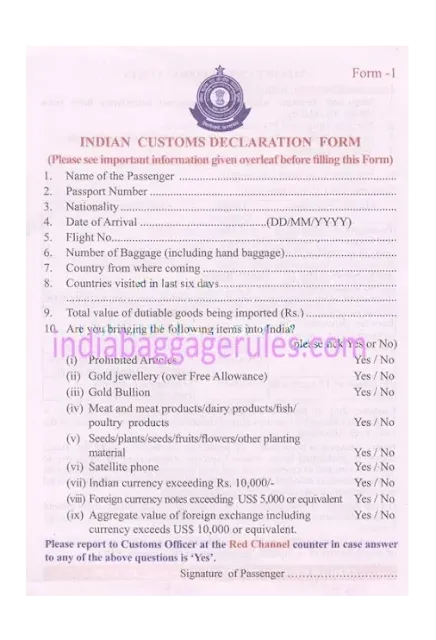
Indian Customs Declaration Form

The Indian Customs Declaration Form is required for travelers carrying dutiable, restricted, or prohibited goods.

How to Fill the Form

  1. Enter personal and passport details
  2. Declare goods like electronics, gold, or high-value gifts
  3. Declare currency exceeding USD 5,000 or total USD 10,000
  4. Submit at customs upon arrival
Indian Customs Declaration Form

Tip: Use the Atithi App to submit your declaration digitally before arrival for faster clearance.

Duty-Free Allowances (2026)

Check full details here: India Duty-Free Allowance 2026

Category Allowance
Indian Residents ₹50,000
Foreign Tourists ₹25,000
Alcohol 2 Liters
Tobacco 100 Cigarettes or 25 Cigars

Used personal items such as clothing and toiletries are fully exempt from customs duty.

Essential Indian Customs Forms

1. Customs Declaration Form

Mandatory for declaring goods and currency.

2. Red vs Green Channel

Green Channel: No dutiable goods

Red Channel: Required if carrying taxable or restricted items

3. Atithi App

Digital platform for submitting declarations in advance.

4. KYC Form

Required for cargo clearance and identity verification.

Key Compliance Rules for Travelers

Failure to declare dutiable goods can result in penalties, confiscation, or legal action.

  • Declare currency above USD 5,000 (cash) or USD 10,000 total
  • Avoid prohibited items like narcotics and wildlife products
  • Pets require NOC, microchip, and vaccination records
  • Report mishandled baggage immediately

Commercial Import Compliance

Required Documentation

  • Manufacturer Invoice
  • Letter of Credit
  • Insurance Documents
  • Import License

Classification System

Goods must be classified under ITC (HS) using 8-digit codes.

Customs clearance is processed through the Electronic Data Interchange (EDI) system for efficiency.

Additional Resources

Customs Guide for Travellers
CBIC Official Website
Bureau of Immigration India

Frequently Asked Questions

Do I need a customs declaration form in India?

Yes, if you are carrying dutiable, restricted, or prohibited goods.

Can I fill out the customs form online?

Yes, you can use the Atithi App to submit declarations before arrival.

What happens if I don't declare goods?

You may face penalties, confiscation, or legal consequences.

Do I need CN22 or CN23 forms?

No, these are for postal shipments, not passenger baggage.

What documents are needed for customs clearance?

Passport, declaration form, invoices (if applicable), and supporting documents.

What are common mistakes on customs forms?

Incorrect values, missing items, and failure to declare currency.

What is the duty-free allowance in India?

₹50,000 for residents and ₹25,000 for foreign tourists.

Is Air Suvidha required?

No, the Air Suvidha form is no longer required for international arrivals to India. Air Suvidha.

Is it a good idea to take Game Console to India ?

Can I bring my PS5 or Xbox to India as a part of Carry on? Taking your game console to India can be a practical choice, especially with m...