Bumped from a Flight in India? Overbooking Rules, Compensation & Passenger Rights Explained

Updated: April 11, 2026

Denied boarding in India? Learn compensation rules, passenger rights

Getting bumped from a flight in India can feel frustrating—but here’s the surprising part: you may be entitled to compensation up to ₹20,000, along with meals, hotel stays, and alternate flights.

Airlines often overbook flights to manage no-shows, but strict rules ensure passengers are protected. This guide walks you through compensation, rights, and how to handle the situation like a pro.

Table of Contents

  • Can Airlines Bump You?
  • Overbooking in India Explained
  • Compensation Rules
  • Who Gets Bumped?
  • Passenger Rights & Care
  • Step-by-Step What To Do
  • Pros & Cons
  • FAQs

Rules You Must Know

Never Do Always Do Instead
Arrive Late at Airport Check-in Early (up to 48 hrs)
Accept Verbal Promises Get Written Denied Boarding Proof
Ignore Receipts Keep All Documents & Bills
Volunteer Without Negotiation Negotiate Compensation First

Can Airlines Bump You from a Flight?

Yes, airlines in India can legally deny boarding due to overbooking. However, they must first ask for volunteers before forcing anyone off a confirmed seat.

If you checked in on time and still got bumped, you are legally entitled to compensation and assistance.

Does Overbooking Happen in India?

Yes—overbooking is common among airlines to offset no-shows. It’s a global practice, but India ensures passengers are denied boarding at the gate, not removed from the plane.

Airlines typically overbook by 5–15% to maximize seat occupancy.

Compensation Rules (2025–2026)

You can receive up to ₹20,000 compensation depending on your delay and choice.

Situation Your Compensation
Alternate flight within 24 hours 200% of fare (Max ₹10,000)
Alternate flight after 24 hours 400% of fare (Max ₹20,000)
No alternate flight accepted Full refund + 400% (Max ₹20,000)

Mandatory Passenger Care

  • Free meals & refreshments
  • Hotel stay (if next-day flight)
  • Alternative travel arrangements

Who Gets Picked for Bumping?

  • Late check-in passengers
  • Low fare ticket holders
  • No seat assignment travelers

Frequent flyers and premium passengers are least likely to be bumped.

What To Do If You Get Bumped

  1. Ask for written denied boarding proof
  2. Confirm compensation eligibility
  3. Request meals or hotel if delayed
  4. Keep all receipts
  5. File complaint if unpaid

Pros & Cons of Airline Overbooking

Pros

  • Higher flight availability
  • Lower ticket prices overall
  • Chance to earn compensation

Cons

  • Risk of denied boarding
  • Travel delays
  • Stress & inconvenience

Pro Tips to Avoid Getting Bumped

  • Check-in as early as possible
  • Select your seat in advance
  • Join airline loyalty programs
  • Avoid last-minute boarding

FAQs

What happens if a flight is overbooked in India?

You may be denied boarding but are entitled to compensation, alternate flights, and care services.

What are my rights if I get bumped?

You have the right to compensation, refund or alternate flight, and free meals or hotel if required.

How much compensation can I get?

Up to ₹20,000 depending on delay and whether you accept an alternate flight.

What if no one volunteers?

The airline will deny boarding involuntarily and must compensate affected passengers.

Which passengers are least likely to be bumped?

Frequent flyers, business class travelers, and early check-in passengers.

Can I file a complaint if airline refuses to pay?

Yes, you can file a complaint with DGCA or approach consumer court.
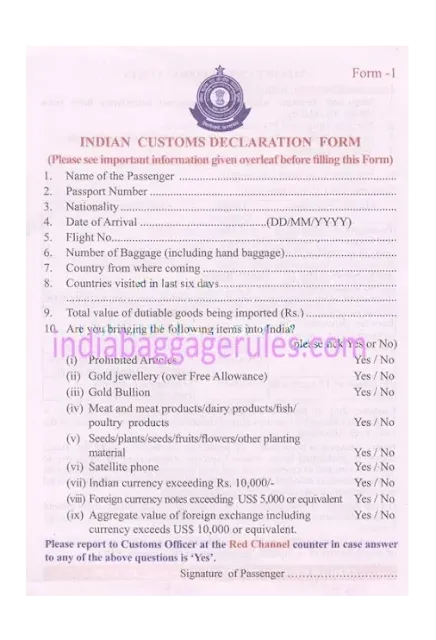
Indian Customs Forms 2026: Declaration, Duty-Free Allowance & Compliance Guide

Updated: April 09, 2026
Indian Customs Declaration Form / Customs compliance for International Travellers

Planning your arrival in India? Understanding Indian customs forms and compliance rules can save you time, money, and unnecessary stress at the airport. This guide walks you through everything—from declaration forms and duty-free limits to key compliance rules—so you can travel confidently and stay fully compliant.

The Atithi app is an official mobile tool created by India’s Central Board of Indirect Taxes and Customs (CBIC) for international travelers. It enables passengers to submit digital declarations for baggage, valuables, and currency before arrival, helping reduce airport wait times and making customs clearance faster and more efficient.

Rules Overview

Never Do Use Instead
Carry undeclared currency above limits Declare amounts exceeding USD 5,000 or USD 10,000 total
Use Green Channel with dutiable goods Always choose Red Channel for declarations
Ignore restricted/prohibited items Check regulations before travel

Indian Customs Declaration Form

The Indian Customs Declaration Form is required for travelers carrying dutiable, restricted, or prohibited goods.

How to Fill the Form

  1. Enter personal and passport details
  2. Declare goods like electronics, gold, or high-value gifts
  3. Declare currency exceeding USD 5,000 or total USD 10,000
  4. Submit at customs upon arrival
Indian Customs Declaration Form

Tip: Use the Atithi App to submit your declaration digitally before arrival for faster clearance.

Duty-Free Allowances (2026)

Check full details here: India Duty-Free Allowance 2026

Category Allowance
Indian Residents ₹50,000
Foreign Tourists ₹25,000
Alcohol 2 Liters
Tobacco 100 Cigarettes or 25 Cigars

Used personal items such as clothing and toiletries are fully exempt from customs duty.

Essential Indian Customs Forms

1. Customs Declaration Form

Mandatory for declaring goods and currency.

2. Red vs Green Channel

Green Channel: No dutiable goods

Red Channel: Required if carrying taxable or restricted items

3. Atithi App

Digital platform for submitting declarations in advance.

4. KYC Form

Required for cargo clearance and identity verification.

Key Compliance Rules for Travelers

Failure to declare dutiable goods can result in penalties, confiscation, or legal action.

  • Declare currency above USD 5,000 (cash) or USD 10,000 total
  • Avoid prohibited items like narcotics and wildlife products
  • Pets require NOC, microchip, and vaccination records
  • Report mishandled baggage immediately

Commercial Import Compliance

Required Documentation

  • Manufacturer Invoice
  • Letter of Credit
  • Insurance Documents
  • Import License

Classification System

Goods must be classified under ITC (HS) using 8-digit codes.

Customs clearance is processed through the Electronic Data Interchange (EDI) system for efficiency.

Additional Resources

Customs Guide for Travellers
CBIC Official Website
Bureau of Immigration India

Frequently Asked Questions

Do I need a customs declaration form in India?

Yes, if you are carrying dutiable, restricted, or prohibited goods.

Can I fill out the customs form online?

Yes, you can use the Atithi App to submit declarations before arrival.

What happens if I don't declare goods?

You may face penalties, confiscation, or legal consequences.

Do I need CN22 or CN23 forms?

No, these are for postal shipments, not passenger baggage.

What documents are needed for customs clearance?

Passport, declaration form, invoices (if applicable), and supporting documents.

What are common mistakes on customs forms?

Incorrect values, missing items, and failure to declare currency.

What is the duty-free allowance in India?

₹50,000 for residents and ₹25,000 for foreign tourists.

Is Air Suvidha required?

No, the Air Suvidha form is no longer required for international arrivals to India. Air Suvidha.

Transporting Refrigerated Medication on India Flights: Complete Travel Guide

Updated: April 07, 2026
How to keep refrigerated medicine cold while traveling?

Traveling with refrigerated medication on India flights can feel overwhelming—but with the right strategy, it’s completely manageable. Whether you're carrying insulin, eye drops, or biologics, maintaining the correct temperature is essential for safety and effectiveness.

India’s diverse climate and long travel times make preparation crucial. This guide simplifies everything—from packing and airline rules to smart travel tips—so you can focus on your journey with confidence.

Key Travel Rules

Never Use Use Instead
Checked luggage for critical meds Carry-on bag for full control
Loose packaging Original labeled containers
No documentation Prescription & doctor’s note
No cooling plan Insulated cooler with gel packs

Important: Aircraft cabins do not provide refrigeration, so your cooling setup is essential.

Choose the Right Packaging

Use a high-quality insulated cooler bag or travel case designed for medications. These should maintain a temperature range of 2–8°C using gel or ice packs.

  • Use medical-grade insulated pouches
  • Choose leak-proof gel packs
  • Keep medication in original packaging

Ice Packs on Flights

Ice packs are allowed on India flights when used for medical purposes. Ensure they are frozen solid during security screening and inform airport staff in advance.

Tip: Carry extra gel packs for long-haul or delayed flights.

How to Pack Refrigerated Medicine

  1. Place medication in original labeled containers
  2. Wrap inside a waterproof pouch
  3. Store inside insulated cooler
  4. Add frozen gel packs around (not directly touching)
  5. Keep in carry-on luggage

Plan Ahead for Air Travel

Choose direct flights when possible and inform your airline in advance if you’re carrying refrigerated medication or special equipment.

Carry-On vs Checked Bags

Carry-On Benefits

  • Better temperature control
  • Easy access during flight
  • Reduced risk of damage

Checked Bag Risks

  • Extreme temperatures
  • Possible delays or loss
  • Limited monitoring

Temperature Monitoring

Use a portable thermometer to ensure your medication stays within the 2–8°C range throughout your journey.

Emergency Preparedness

Carry backup medication, extra cooling packs, and research pharmacies at your destination in case of delays.

Warning: Temperature fluctuations can reduce medication effectiveness—always monitor conditions closely.

Medications That Need Refrigeration

  • Insulin and injectable biologics
  • Vaccines
  • Certain eye and ear drops
  • Specialty medications and biologics

FAQs

Can you fly with refrigerated medication?

Yes, you can fly with refrigerated medication. Keep it in your carry-on inside an insulated cooler with gel packs and inform airport security.

How to take fridge medication on a plane?

Use a medical cooler with frozen gel packs, keep medications in original packaging, and carry a prescription or doctor’s note.

Can we carry medicines in flight in India?

Yes, both prescription and over-the-counter medicines are allowed in carry-on luggage on India flights.

How do I pack OTC medication for a flight?

Keep OTC medicines in original packaging, place them in a clear bag, and pack them in your carry-on for easy access.

Can I carry OTC medicines on international flights?

Yes, OTC medicines are allowed internationally, but it's best to carry them in labeled packaging and check destination rules.

Do I need to declare my prescriptions at customs?

In most cases, yes. Declare prescription medications, especially controlled substances, and carry supporting documentation.

Can I put refrigerated medication in checked luggage?

It is not recommended due to temperature fluctuations. Always carry it in your cabin bag.

Related Resources:

Bringing Medicines from India

Do airport x-rays affect medications

Transporting Refrigerated Medication on India Flights

Travelling with Medicines to India

External Resources:

Air India: Medical Needs Clearance

Can You Bring Contact Solution on a Flight? Rules for Carry-On & Checked Bags

Updated: April 05, 2026
Carrying Contact Lens Solution on India Domestic Flight?

Planning to fly with contact lenses? Good news—you can absolutely bring contact solution on a plane. But like most liquids, there are a few important rules you need to follow to avoid delays at airport security.

This complete guide breaks down exactly what’s allowed, what to avoid, and how to pack smart so you can travel comfortably without any last-minute surprises.

Flight Rules for Contact Solution

Never Do Use Instead
Carry large bottles in carry-on without declaring Use travel-size bottles (100ml or less)
Pack liquids loosely in bags Use a clear zip-top plastic bag
Ignore medical liquid declaration rules Inform security if carrying larger quantities
Risk leaks in your luggage Seal bottles in plastic bags

Key Insight: Contact lens solution is considered a medically necessary liquid, which means you can carry more than the standard limit—but you must declare it at security.

Carry-On vs Checked Baggage

Carry-On Rules

You can bring contact solution in your carry-on if it follows the 3-1-1 rule. That means containers must be 100 ml (3.4 oz) or smaller and fit inside one clear, resealable bag.

Larger Bottles

If you need a larger bottle, you can still carry it, but you must declare it to security officers. It may go through additional screening.

Warning: Some peroxide-based solutions may trigger alarms during screening, especially those with red caps.

Checked Baggage

There are no strict size limits in checked luggage, making it the best option for longer trips.

Is Saline Solution Allowed?

Yes, saline solution is allowed in carry-on luggage under the same rules as contact solution.

For convenience and faster screening, keep saline solution in travel-size bottles and store them in your liquids bag.

Can You Use Travel Bottles?

Yes, transferring solution into travel-sized bottles is a smart move for flying.

Always use clean, leak-proof bottles and label them properly to avoid confusion during security checks.

Flying with Contact Lenses

Carry-On Essentials

You can carry contact lenses easily in your carry-on. They are not restricted like liquids when stored in a lens case.

Extra Safety

It’s always a good idea to carry extra lenses and a backup pair of glasses in case of irritation or loss.

1. Pack lenses in a secure case

2. Keep solution accessible

3. Carry backup glasses

4. Bring rewetting drops

Smart Packing Tips for Contact Lens Users

Best Practices

  • Use travel-size bottles
  • Pack liquids in a clear bag
  • Carry backup glasses
  • Keep items easily accessible

Avoid These Mistakes

  • Overpacking liquids
  • Ignoring leak protection
  • Forgetting to declare large bottles
  • Using unclean containers

Frequently Asked Questions

Can you bring contact solution on a plane?

Yes, contact solution is allowed in both carry-on and checked baggage, following liquid rules and security guidelines.

How big of a bottle can I bring?

You can bring bottles up to 100 ml in carry-on. Larger bottles must be declared or packed in checked luggage.

Will airport security take my contact solution?

No, as long as it meets liquid rules or is declared properly, your contact solution will not be taken.

Is contact lens solution considered a medical liquid?

Yes, it is classified as medically necessary, which allows some flexibility beyond standard liquid limits.

Can I carry saline solution in my carry-on?

Yes, saline solution is allowed under the same liquid restrictions as contact solution.

Should I pack contact solution in checked baggage?

For long trips, it is easier to pack larger bottles in checked luggage to avoid restrictions.

Children's Items Banned in Hand Luggage: Must-Know Family Travel Rules

Updated: April 05, 2026
What Children's Items Are Not Allowed in Hand Luggage?

Traveling with kids is exciting—but unexpected airport security rules can quickly turn it stressful. From toy guns to battery-powered gadgets, knowing what’s allowed in hand luggage can save you from last-minute surprises. This guide breaks down everything you need to pack smart, travel stress-free, and keep your little ones happy throughout the journey.

What Children's Items Are Not Allowed in Hand Luggage?

Key takeaway: Items that resemble weapons, contain liquids, or have restricted electronics are commonly banned.

Some children’s items are restricted due to safety concerns. These include:

  • Toy guns (Nerf guns, water guns)
  • Slime and play dough
  • Toy drones
  • Seat extenders and inflatable cubes

General Hand Luggage Restrictions

Beyond kids’ items, airlines restrict:

Never CarryUse Instead
Liquids over 100mlTravel-size containers
Sharp objectsPack in checked baggage
Toy weaponsSoft toys or puzzles

Are Battery Toys Allowed in Hand Luggage?

Battery-operated toys are allowed—but lithium batteries must be under 100Wh and remain inside the device.

  • AA/AAA batteries: Allowed
  • Lithium batteries: Restricted
  • Spare batteries: Must be insulated

Can Kids Bring Toys on a Plane?

Allowed:

  • Stuffed animals
  • Small plastic toys
  • Books and puzzles

Not Allowed:

  • Toy guns
  • Toy swords
  • Loud electronic toys

Can I Bring Kid Snacks on a Plane?

  • Solid snacks: Allowed
  • Liquid snacks: Must follow 100ml rule
  • International travel: Check food restrictions

Are Soccer Balls Allowed?

Yes—but they should be deflated to prevent cabin pressure issues.

Are RC Cars Allowed?

RC toys are allowed if:

  • Batteries remain inside the device
  • Spare batteries are protected

Are Baby Accessories Allowed?

Some accessories are banned due to safety risks:

  • Seat extenders
  • Inflatable bed boxes
  • Leg hammocks

Are Toy Drones Allowed?

Most airlines restrict drones in hand luggage. Always check airline rules before packing.

Carry-On Limits for Kids’ Items

  1. Check airline weight limits (7–10 kg typical)
  2. Follow size restrictions
  3. Review battery rules

Multi-Leg Journey Rules

Each airline may have different policies. Always check rules for every leg of your journey.

FAQs

What children's items are banned in hand luggage?

Toy weapons, slime, drones, and certain baby accessories are commonly restricted.

Are battery toys allowed?

Yes, but lithium batteries must meet airline safety limits.

Can kids bring snacks?

Solid snacks are allowed, while liquids must follow the 100ml rule.

Are stuffed toys allowed?

Yes, unless they contain large electronic components.

Can I bring a soccer ball?

Yes, but it should be deflated.

Are drones allowed in hand luggage?

Usually restricted; check airline policies.

Airline Seats Getting Thinner—and Could Your Back Pay the Price?

Have you settled into an airline seat and wondered where the cushion went? A seat that feels tolerable for a short domestic hop can become ...