Showing posts with label Forms. Show all posts

Air Suvidha 2.0 Form for India Travel

Updated: July 14, 2026

Air Suvidha 2.0 Form for India Travel

Air Suvidha is back, and this time the confusion is different. Many travellers remember the old COVID-era form and assume it is outdated, but India has reintroduced Air Suvidha 2.0 under a health advisory linked to the ongoing Ebola disease outbreak.


International passengers arriving in India should complete the Air Suvidha 2.0 Self-Declaration Form before travel using the official portal. Fill all mandatory fields correctly, save the confirmation, and keep it ready for airline or health authority checks.

Quick Answer: Is Air Suvidha 2.0 Required Now?

Yes, Air Suvidha 2.0 is currently required for air travellers arriving in India under the June 2026 health advisory related to the Ebola disease outbreak. Passengers should complete the Self-Declaration Form before starting travel and fill all mandatory information correctly for smoother arrival clearance.

India Travel Forms

Requirement Current Practical Answer Why It Matters
Air Suvidha 2.0 Self-Declaration Form Required under the current health advisory Used by health authorities for arrival monitoring and assistance
Passport Required Needed for international travel and immigration
Visa, e-Visa or OCI Required depending on traveller status Air Suvidha does not replace entry permission
India e-Arrival Card May apply to foreign nationals and OCI cardholders Separate immigration arrival process
Customs declaration Required if carrying dutiable or restricted goods Separate from Air Suvidha health declaration

What Changed in June 2026?

Air Suvidha was earlier known as a COVID-era arrival form. It was later discontinued for routine India arrivals after pandemic travel rules eased. In June 2026, the Government of India reactivated the Air Suvidha system as Air Suvidha 2.0 in view of an ongoing Ebola disease outbreak and related health surveillance requirements.

The new form is a health self-declaration. It helps health authorities collect passenger travel history, contact details, possible exposure information, and symptom-related information before or during arrival clearance.

Important update: older articles saying “Air Suvidha is not required” may now be outdated. Check the official Air Suvidha 2.0 portal and airline instructions before departure.

Who Must Fill the Air Suvidha 2.0 Form?

The official Air Suvidha 2.0 FAQ language says air travellers arriving in India are required to fill the Self-Declaration Form under the current health advisory. Travellers should follow the official portal and airline instructions for their route.

Passengers who should be prepared to complete it

  • Indian citizens arriving from abroad.
  • NRIs travelling to India.
  • OCI cardholders arriving in India.
  • Foreign nationals entering India.
  • Tourists, business travellers, students and medical visitors.
  • Passengers arriving directly or through transit routes.
  • Families travelling with children.
  • Senior citizens and passengers needing health assistance.

Do not assume nationality gives an exemption. Health self-declaration requirements can apply based on arrival into India, not only passport type.

When Should You Submit the Form?

Submit the Air Suvidha 2.0 Self-Declaration Form before starting travel to India. Completing it early reduces check-in stress and helps avoid last-minute airport problems if airline staff ask for confirmation.

The safest approach is to complete it before web check-in or before reaching the departure airport. If your airline sends a document reminder, follow the airline’s timing carefully.

Best timing: fill the Air Suvidha 2.0 form before leaving for the airport, save the confirmation on your phone, and keep a printed copy if travelling with family, seniors or children.

Why early submission helps

  • Reduces check-in counter delays.
  • Gives time to correct passport or flight details.
  • Helps if the airline asks for proof before boarding.
  • Helps health authorities review arrival information if needed.
  • Avoids portal access problems at the last minute.

What Information Is Needed?

The Air Suvidha 2.0 Self-Declaration Form asks for passenger, travel, contact and health-related information. Mandatory fields are usually marked with an asterisk and must be completed correctly.

Keep these details ready

  • Full name as shown on passport.
  • Passport number and nationality.
  • Date of birth and contact details.
  • Flight number and airline.
  • Country of departure.
  • Transit countries, if any.
  • Arrival airport in India.
  • Address and contact details in India.
  • Recent travel history, including the required lookback period if asked.
  • Health or symptom information requested by the form.
  • Emergency contact details.

Accuracy matters: wrong passport number, wrong flight number, incomplete travel history or missing contact information can create avoidable checks at the airport.

How to Fill the Air Suvidha 2.0 Form

Use the official Air Suvidha portal, not a paid imitation website. The form should be completed carefully because it is connected to arrival health monitoring.

  1. Open the official Air Suvidha 2.0 portal.
  2. Start the Self-Declaration Form.
  3. Enter passport and passenger details exactly as shown on travel documents.
  4. Enter flight number, departure country, transit details and arrival airport.
  5. Provide contact details and address in India.
  6. Complete travel history and health-related questions honestly.
  7. Review every mandatory field before submission.
  8. Submit the form and save the confirmation.
  9. Carry a digital and printed copy if possible.

Do not submit false health or travel information. The form is used for public health monitoring and arrival assistance. Incorrect details may cause problems during arrival clearance.

What to Do After Submission

After submitting the Air Suvidha 2.0 form, save the confirmation immediately. Do not rely only on email delivery, because airport Wi-Fi, roaming data or inbox access may fail at the check-in counter.

After submitting, keep

  • Screenshot of the confirmation page.
  • PDF or email confirmation if provided.
  • Passport and visa or OCI documents.
  • Boarding pass or ticket copy.
  • India address and contact number.
  • Travel insurance and medical records if relevant.
  • Printed copy for senior citizens or children where useful.

Family travel tip: create one folder on your phone named “India Travel Documents” and save each passenger’s Air Suvidha confirmation, passport copy, visa or OCI proof, and ticket.

Air Suvidha 2.0 vs Old Air Suvidha COVID Form

Air Suvidha 2.0 is not the same travel situation as the old COVID-era process, but the purpose is similar: health self-declaration before arrival. The earlier Air Suvidha process was mainly tied to COVID-19 travel restrictions, RT-PCR uploads, vaccination status and pandemic screening.

Feature Old Air Suvidha Air Suvidha 2.0
Main health context COVID-19 travel period Ebola-related health advisory and surveillance
Purpose Health and travel declaration Health self-declaration and arrival monitoring
Who used it International arrivals during relevant COVID rules Travellers arriving in India under the current advisory
Documents Previously included RT-PCR or vaccination details when required Current form fields depend on official portal requirements
Best source Historical COVID-era advisories Current official Air Suvidha 2.0 portal and airline instructions

Air Suvidha 2.0 vs India e-Arrival Card

Air Suvidha 2.0 and the India e-Arrival Card are separate. Air Suvidha 2.0 is a health self-declaration. The India e-Arrival Card is connected to immigration arrival information for applicable travellers.

Form Purpose Do Not Confuse With
Air Suvidha 2.0 Health self-declaration for India arrival Visa, e-Visa or immigration approval
India e-Arrival Card Digital arrival information for immigration Health declaration
Customs declaration Declaration of dutiable, restricted or high-value goods Air Suvidha or immigration form
Indian e-Visa Entry permission before travel Air Suvidha confirmation

Main difference: Air Suvidha 2.0 is about health declaration. e-Arrival is about immigration arrival information. Customs declaration is about goods and currency.

For more detail, read e-Arrival Card India Immigration and Indian Immigration Arrival Form.

Customs, Visa and Arrival Rules Still Apply

Completing Air Suvidha 2.0 does not replace your passport, visa, OCI card, e-Arrival Card, customs declaration or baggage rules. It is only one part of the travel process.

Before flying to India, still check

  • Passport validity.
  • Visa, e-Visa or OCI status.
  • Return or onward ticket if required by airline or visa category.
  • India e-Arrival Card where applicable.
  • Customs declaration for gold, currency, electronics, alcohol or restricted goods.
  • Medicines and prescription documents.
  • Transit country requirements.
  • Airline baggage and check-in rules.

Travel document warning: Air Suvidha confirmation does not give you permission to enter India. You still need valid travel and immigration documents.

For customs help, read Indian Customs Declaration Form, What Should Be Declared at Indian Customs?, and India Customs Red Channel vs Green Channel.

What Happens If You Forget to Fill It?

If you forget to complete Air Suvidha 2.0 before travel, you may face check-in delays, boarding questions or arrival clearance delays depending on airline and airport enforcement. The safest action is to complete the form immediately using the official portal.

If you forgot the form

  1. Do not panic.
  2. Open the official Air Suvidha portal immediately.
  3. Complete the Self-Declaration Form before check-in or boarding if possible.
  4. Ask airline staff if they require confirmation before issuing a boarding pass.
  5. Save the confirmation screenshot.
  6. Keep passport, visa, ticket and India address ready.
  7. At arrival, follow health authority instructions if asked.

Airport tip: complete the form before reaching the check-in counter. Trying to fill it while standing in line can cause mistakes and delay your boarding process.

Avoid Unofficial Air Suvidha Websites

Whenever a travel form becomes mandatory, unofficial websites may appear in search results. Some may charge service fees, use outdated information, or imitate official wording. Use only official government or airport sources for Air Suvidha 2.0.

Red flags to watch for

  • Website charges a high fee for a government health declaration.
  • Website does not clearly show an official government domain.
  • Website mixes Air Suvidha, visa, customs and e-Arrival into one paid package.
  • Website promises guaranteed entry into India.
  • Website asks for unnecessary payment details before showing the form.
  • Website uses old COVID wording without mentioning the current advisory.

Payment warning: do not pay a random website just because it appears first in search results. Use the official Air Suvidha portal and official government links.

India Arrival Checklist

Use this checklist before your flight, especially if you are travelling with family, seniors, children or connecting through another country.

  1. Complete Air Suvidha 2.0 Self-Declaration Form.
  2. Save the confirmation screenshot or PDF.
  3. Check passport validity.
  4. Confirm visa, e-Visa or OCI status.
  5. Complete India e-Arrival Card if applicable.
  6. Check airline document advisory.
  7. Check transit-country rules.
  8. Prepare prescriptions for important medicines.
  9. Keep India address and contact number ready.
  10. Check customs rules for gold, cash, alcohol and electronics.
  11. Carry invoices for expensive new items.
  12. Use Red Channel if carrying dutiable or restricted goods.

Common Mistakes to Avoid

  • Using an old article that says Air Suvidha is not required.
  • Confusing Air Suvidha 2.0 with the India e-Arrival Card.
  • Thinking Air Suvidha replaces a visa or OCI card.
  • Waiting until boarding time to complete the form.
  • Entering the wrong passport number or flight number.
  • Skipping travel history or health fields.
  • Not saving the confirmation after submission.
  • Using unofficial paid portals without checking the official source.
  • Assuming children or OCI cardholders are automatically exempt.
  • Ignoring customs declaration rules because the health form is complete.
  • Not checking transit-country requirements.
  • Relying only on airport Wi-Fi to access documents.

Bottom Line

Air Suvidha 2.0 is currently required for passengers arriving in India under the June 2026 health advisory related to the Ebola disease outbreak. Complete the Self-Declaration Form before travel, fill all mandatory fields correctly, and save the confirmation.

Do not confuse Air Suvidha 2.0 with the e-Arrival Card, visa, OCI, or customs declaration. You may need more than one document depending on your nationality, route, baggage and arrival status.

Frequently Asked Questions

Is Air Suvidha form mandatory for India travel now?

Yes, Air Suvidha 2.0 is currently required for air travellers arriving in India under the June 2026 health advisory related to the Ebola disease outbreak.

Who must fill the Air Suvidha 2.0 form?

International air travellers arriving in India should be prepared to complete the Air Suvidha 2.0 Self-Declaration Form as required by the current advisory and airline instructions.

When should I fill the Air Suvidha 2.0 form?

Fill it before starting travel to India, preferably before reaching the airport or before web check-in, so you have time to correct mistakes and save the confirmation.

What information is required in Air Suvidha 2.0?

You may need passport details, flight details, contact information, address in India, travel history, transit information and health-related declarations requested by the official form.

Is Air Suvidha 2.0 the same as the India e-Arrival Card?

No. Air Suvidha 2.0 is a health self-declaration form. The India e-Arrival Card is an immigration arrival information process for applicable travellers.

Does Air Suvidha replace my visa or OCI card?

No. Air Suvidha does not replace a visa, e-Visa, passport or OCI card. You still need valid entry documents for India.

What happens if I forget to fill Air Suvidha 2.0?

You may face check-in, boarding or arrival clearance delays. Complete the form immediately through the official portal and save the confirmation.

Where is the official Air Suvidha 2.0 form?

Use the official Air Suvidha portal at airsuvidha.civilaviation.gov.in and avoid unofficial paid websites unless you have verified the source.

e-Arrival Card India: Who Needs It

Updated: July 11, 2026

e-Arrival Card India: Who Needs It

India’s arrival process now includes more digital forms, and many travellers confuse the e-Arrival Card with Air Suvidha, e-Visa, OCI, or the customs declaration form. Filling the wrong form, skipping the required one, or using an unofficial paid website can create avoidable airport stress.


The India e-Arrival Card is a free digital arrival information form for foreign nationals and OCI cardholders where applicable. It does not replace your passport, visa, e-Visa, OCI card, Air Suvidha 2.0 health declaration, or customs declaration.

Quick Answer: What Is India’s e-Arrival Card?

The India e-Arrival Card is an online arrival information form for foreign nationals and OCI cardholders entering India. It is used for immigration arrival details and should be completed through official government platforms within the allowed pre-arrival window.

Question Answer Important Note
Is the e-Arrival Card a visa? No You still need a valid visa, e-Visa, OCI card or other entry permission
Is it the same as Air Suvidha? No Air Suvidha 2.0 is a health declaration; e-Arrival is immigration information
Is it the same as customs declaration? No Customs declaration is for goods, currency, gold and restricted items
Who commonly needs it? Foreign nationals and OCI cardholders Check the official portal and airline instructions before travel
Should each traveller submit separately? Yes, where applicable Children and babies with foreign passports may need separate submissions

Who Needs the India e-Arrival Card?

Foreign nationals entering India should check whether the e-Arrival Card applies to their trip. This includes tourists, business visitors, students, medical visitors, family visitors, conference travellers, employment visa holders and other foreign passport holders.

OCI cardholders should also check the e-Arrival Card requirement because OCI status is not Indian citizenship. OCI travellers enter India on a foreign passport with OCI status, so digital arrival information may still be required.

Travellers who should check the e-Arrival Card

  • Foreign tourists with regular Indian visas.
  • Foreign travellers with Indian e-Visas.
  • Business travellers.
  • Students entering India.
  • Medical visa travellers.
  • Conference or employment visa holders.
  • Foreign passport holders visiting family in India.
  • OCI cardholders.
  • Foreign national babies and children.

Travel tip: if you are not travelling on an Indian passport, check the e-Arrival Card portal before departure.

Who Does Not Need the e-Arrival Card?

Indian citizens travelling on Indian passports are generally treated differently from foreign nationals and OCI cardholders. They should still carry a valid Indian passport and follow airline, health, immigration and customs instructions, but the e-Arrival Card is mainly aimed at foreign passport holders.

Traveller Type e-Arrival Card? Documents to Carry
Indian citizen with Indian passport Usually no Indian passport and airline documents
Foreign national with regular visa Check / generally yes where applicable Passport, visa and e-Arrival confirmation
Foreign national with e-Visa Check / generally yes where applicable Passport, e-Visa approval and e-Arrival confirmation
OCI cardholder Check / generally yes where applicable Foreign passport, OCI proof and e-Arrival confirmation
Foreign passport child or baby Check / generally yes where applicable Child passport, visa or OCI proof and separate e-Arrival confirmation

Important: requirements can change. Always confirm with the official e-Arrival portal and your airline before departure.

e-Arrival Card vs Air Suvidha 2.0

The e-Arrival Card and Air Suvidha 2.0 are separate forms. The e-Arrival Card is connected to immigration arrival information. Air Suvidha 2.0 is a health self-declaration form reintroduced under the health advisory related to the Ebola disease outbreak.

Form Main Purpose What It Does Not Replace
e-Arrival Card Immigration arrival information Visa, OCI, Air Suvidha or customs declaration
Air Suvidha 2.0 Health self-declaration Visa, e-Arrival Card or customs declaration
Customs Declaration Form Goods, currency, gold, alcohol and restricted items Immigration or health forms

Main difference: e-Arrival tells immigration where you are coming from and staying. Air Suvidha 2.0 gives health and travel-history information. Customs declaration tells Customs what goods or currency you are carrying.

For the health form, read Air Suvidha 2.0 Form for India Travel. For a full checklist, read India Travel Forms: Air Suvidha and e-Arrival.

e-Arrival Card vs e-Visa and OCI

The India e-Arrival Card is not a travel authorization. It does not give permission to enter India by itself. A foreign national still needs the correct visa, e-Visa, OCI card or other entry permission before boarding and arrival.

What each document does

  • Passport: proves your identity and nationality for international travel.
  • Visa or e-Visa: gives permission to enter India for a specific purpose and period.
  • OCI card: gives eligible overseas citizens of India long-term entry benefits, but it is not Indian citizenship.
  • e-Arrival Card: submits arrival information before immigration clearance.

Entry warning: an e-Arrival Card confirmation will not fix an expired passport, missing visa, wrong visa category or OCI mismatch.

Use Indian Visa Online for visa and e-Visa information and OCI Services for OCI-related services.

When Should You Submit the e-Arrival Card?

Submit the e-Arrival Card within the official pre-arrival window shown on the portal. The common guidance is to complete it close to travel, after your flight details and India address are confirmed, and before reaching India.

Do not wait until after landing. Airport Wi-Fi, roaming data, family delays, tired children or immigration queues can make last-minute form submission stressful.

Best timing: complete the e-Arrival Card after your flight and first address in India are confirmed, then save the confirmation before starting your international journey.

What Information Is Required?

The e-Arrival Card asks for traveller, passport, visa or OCI, flight and stay details. Keep your documents ready before opening the form.

Information you may need

  • Full name as shown on passport.
  • Date of birth, gender and nationality.
  • Passport number, issue details and expiry date.
  • Visa or e-Visa details, if applicable.
  • OCI details, if applicable.
  • Arrival date and port of arrival.
  • Flight number.
  • Purpose of visit.
  • First address in India, such as hotel, family home or business address.
  • Email address and phone number.
  • Recent travel history if asked.

Before submitting: check passport number, spelling, date of birth, flight number and India address carefully. Small errors can create avoidable immigration questions.

Do Children and Babies Need an e-Arrival Card?

Foreign national children and babies, including those with OCI status, may need their own e-Arrival Card submission. Parents or guardians should complete the form for each child using the child’s own passport and visa or OCI details.

Child e-Arrival reminders

  • Do not put the child only on the parent’s form if separate submission is required.
  • Use the child’s own passport number.
  • Use the child’s own visa or OCI details.
  • Keep the child’s confirmation with the family travel documents.
  • Carry birth certificate or relationship proof if useful for travel.
  • Indian citizen children travelling on Indian passports are generally treated differently.

Family tip: fill all family forms together so flight number, arrival date and India address match across submissions.

How to Fill the India e-Arrival Card

The form is usually simple, but it should not be rushed. Use official platforms only and copy details directly from your passport and visa documents.

  1. Open the official India e-Arrival Card portal or official app route.
  2. Enter your personal details exactly as shown on your passport.
  3. Add passport details carefully.
  4. Add visa, e-Visa or OCI details if applicable.
  5. Enter flight number, arrival airport and arrival date.
  6. Add your first address in India.
  7. Review all fields before submission.
  8. Submit the form within the allowed window.
  9. Save the confirmation as a screenshot, PDF or email.
  10. Print a copy if travelling with seniors, children or family groups.

Do not use guesswork. If your hotel or India address is not confirmed yet, wait until it is confirmed but do not wait until the airport queue.

What to Do After Submitting

After submission, keep the confirmation ready with your passport, visa or OCI documents. Airline staff or immigration officers may ask for proof, especially while the process is still new to some travellers.

Save these together

  • e-Arrival Card confirmation.
  • Passport copy.
  • Visa, e-Visa or OCI proof.
  • Air Suvidha 2.0 confirmation if required.
  • Flight ticket or boarding pass.
  • Hotel or India address.
  • Emergency contact details.
  • Customs declaration documents if needed.

Offline copy tip: save the confirmation in your phone gallery or files app, not only inside email. Email may not load at the immigration counter.

Does e-Arrival Replace Customs Declaration?

No. The e-Arrival Card does not replace the India Customs Declaration Form. Immigration and Customs are separate processes. You may complete e-Arrival correctly and still need to declare goods at Customs.

Use customs declaration when carrying

  • Gold, silver, jewellery or precious stones above permitted limits.
  • Foreign currency above declaration thresholds.
  • Indian currency above permitted limits.
  • Alcohol or tobacco above allowed limits.
  • New sealed phones, tablets, laptops or expensive electronics above allowance.
  • Commercial quantities of goods.
  • Drones, satellite phones, walkie-talkies or restricted communication devices.
  • Restricted medicines, plants, seeds, food or animal products.

Customs rule: e-Arrival helps immigration. It does not clear your baggage through Green Channel.

For customs guidance, read Indian Customs Declaration Form, What Should Be Declared at Indian Customs?, and India Customs Red Channel vs Green Channel.

Avoid Unofficial Paid e-Arrival Websites

The e-Arrival Card should be completed through official government platforms. Be careful with third-party pages that charge for simple form submission, collect unnecessary data, or use official-looking names.

Red flags

  • The website charges a large fee for an arrival information form.
  • The website promises guaranteed entry into India.
  • The website combines e-Arrival, e-Visa, Air Suvidha and customs into one confusing paid package.
  • The website does not use a clear official government domain.
  • The website asks for unnecessary payment details before showing the form.
  • The website copies official wording but gives no official contact or policy source.

Data warning: e-Arrival forms use passport and travel details. Use official portals to reduce unnecessary privacy and payment risk.

Common Mistakes to Avoid

  • Thinking e-Arrival Card is the same as Air Suvidha 2.0.
  • Thinking e-Arrival Card replaces an Indian visa or OCI card.
  • Forgetting that OCI cardholders travel on foreign passports.
  • Submitting the form outside the allowed timing window.
  • Entering the wrong passport number.
  • Using a nickname instead of passport name.
  • Not filling a separate form for foreign national children where required.
  • Not having the first address in India ready.
  • Using an unofficial paid website.
  • Failing to save confirmation offline.
  • Ignoring customs declaration rules after completing e-Arrival.
  • Waiting until the immigration queue to fill the form.

Bottom Line

The India e-Arrival Card is a digital immigration arrival form for foreign nationals and OCI cardholders where applicable. It is free through official platforms and should be completed within the official pre-arrival window.

Do not confuse it with Air Suvidha 2.0, e-Visa, OCI, or customs declaration. Complete the right form, save confirmation offline, and carry your passport, visa or OCI proof, Air Suvidha confirmation if required, and customs documents if you are carrying declarable goods.

Frequently Asked Questions

Do we need to fill an Arrival Card for India?

Foreign nationals and OCI cardholders should check and complete the India e-Arrival Card where applicable before arrival. Indian passport holders are generally treated differently.

What is e-Arrival in India?

e-Arrival in India is a digital arrival information system used by foreign nationals and OCI cardholders to submit immigration details before entering India.

Is the India e-Arrival Card the same as Air Suvidha?

No. The e-Arrival Card is for immigration arrival information. Air Suvidha 2.0 is a health self-declaration form.

What is required for a US citizen to enter India?

A US citizen usually needs a valid passport, valid Indian visa or e-Visa, e-Arrival Card where applicable, and Air Suvidha 2.0 if required under the current health advisory.

What is required for an OCI cardholder to enter India?

An OCI cardholder should carry a valid foreign passport, OCI card or e-OCI proof, e-Arrival Card confirmation where applicable, and any required health declaration such as Air Suvidha 2.0.

Do babies need a separate India e-Arrival Card?

Foreign national babies and children may need separate e-Arrival Card submissions. Parents or guardians should complete the form using each child’s passport and visa or OCI details.

Is the India e-Arrival Card free?

Yes, the e-Arrival Card should be completed through official government platforms. Avoid unofficial sites that charge unnecessary service fees.

Does e-Arrival replace customs declaration?

No. e-Arrival is for immigration. You still need a customs declaration if carrying dutiable goods, restricted items, gold, excess currency, alcohol or high-value electronics.

Indian Customs Forms 2026: Declaration, Duty-Free Allowance & Compliance Guide

Updated: April 09, 2026
Indian Customs Declaration Form / Customs compliance for International Travellers

Planning your arrival in India? Understanding Indian customs forms and compliance rules can save you time, money, and unnecessary stress at the airport. This guide walks you through everything—from declaration forms and duty-free limits to key compliance rules—so you can travel confidently and stay fully compliant.

The Atithi app is an official mobile tool created by India’s Central Board of Indirect Taxes and Customs (CBIC) for international travelers. It enables passengers to submit digital declarations for baggage, valuables, and currency before arrival, helping reduce airport wait times and making customs clearance faster and more efficient.

Rules Overview

Never Do Use Instead
Carry undeclared currency above limits Declare amounts exceeding USD 5,000 or USD 10,000 total
Use Green Channel with dutiable goods Always choose Red Channel for declarations
Ignore restricted/prohibited items Check regulations before travel

Indian Customs Declaration Form

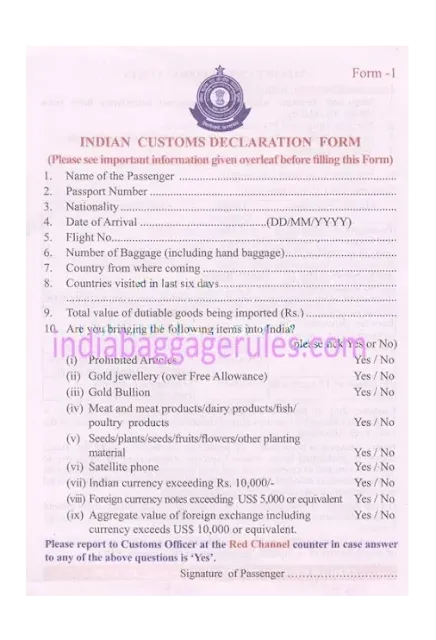
The Indian Customs Declaration Form is required for travelers carrying dutiable, restricted, or prohibited goods.

How to Fill the Form

  1. Enter personal and passport details
  2. Declare goods like electronics, gold, or high-value gifts
  3. Declare currency exceeding USD 5,000 or total USD 10,000
  4. Submit at customs upon arrival
Indian Customs Declaration Form

Tip: Use the Atithi App to submit your declaration digitally before arrival for faster clearance.

Duty-Free Allowances (2026)

Check full details here: India Duty-Free Allowance 2026

Category Allowance
Indian Residents ₹50,000
Foreign Tourists ₹25,000
Alcohol 2 Liters
Tobacco 100 Cigarettes or 25 Cigars

Used personal items such as clothing and toiletries are fully exempt from customs duty.

Essential Indian Customs Forms

1. Customs Declaration Form

Mandatory for declaring goods and currency.

2. Red vs Green Channel

Green Channel: No dutiable goods

Red Channel: Required if carrying taxable or restricted items

3. Atithi App

Digital platform for submitting declarations in advance.

4. KYC Form

Required for cargo clearance and identity verification.

Key Compliance Rules for Travelers

Failure to declare dutiable goods can result in penalties, confiscation, or legal action.

  • Declare currency above USD 5,000 (cash) or USD 10,000 total
  • Avoid prohibited items like narcotics and wildlife products
  • Pets require NOC, microchip, and vaccination records
  • Report mishandled baggage immediately

Commercial Import Compliance

Required Documentation

  • Manufacturer Invoice
  • Letter of Credit
  • Insurance Documents
  • Import License

Classification System

Goods must be classified under ITC (HS) using 8-digit codes.

Customs clearance is processed through the Electronic Data Interchange (EDI) system for efficiency.

Additional Resources

Customs Guide for Travellers
CBIC Official Website
Bureau of Immigration India

Frequently Asked Questions

Do I need a customs declaration form in India?

Yes, if you are carrying dutiable, restricted, or prohibited goods.

Can I fill out the customs form online?

Yes, you can use the Atithi App to submit declarations before arrival.

What happens if I don't declare goods?

You may face penalties, confiscation, or legal consequences.

Do I need CN22 or CN23 forms?

No, these are for postal shipments, not passenger baggage.

What documents are needed for customs clearance?

Passport, declaration form, invoices (if applicable), and supporting documents.

What are common mistakes on customs forms?

Incorrect values, missing items, and failure to declare currency.

What is the duty-free allowance in India?

₹50,000 for residents and ₹25,000 for foreign tourists.

Is Air Suvidha required?

No, the Air Suvidha form is no longer required for international arrivals to India. Air Suvidha.

Can You Carry a Car Seat on Indian Flights

Can You Carry a Car Seat on Indian Flights? Yes, you can usually carry a child car seat when flying in India, but how you carry it depe...